What to take away
- Confirm the intended reader and requirements first.
- Distinguish evidence, commitments and assumptions.
- Reconcile sales volume with capacity and cash timing.
- Use a dated evidence folder and review the numbers together.
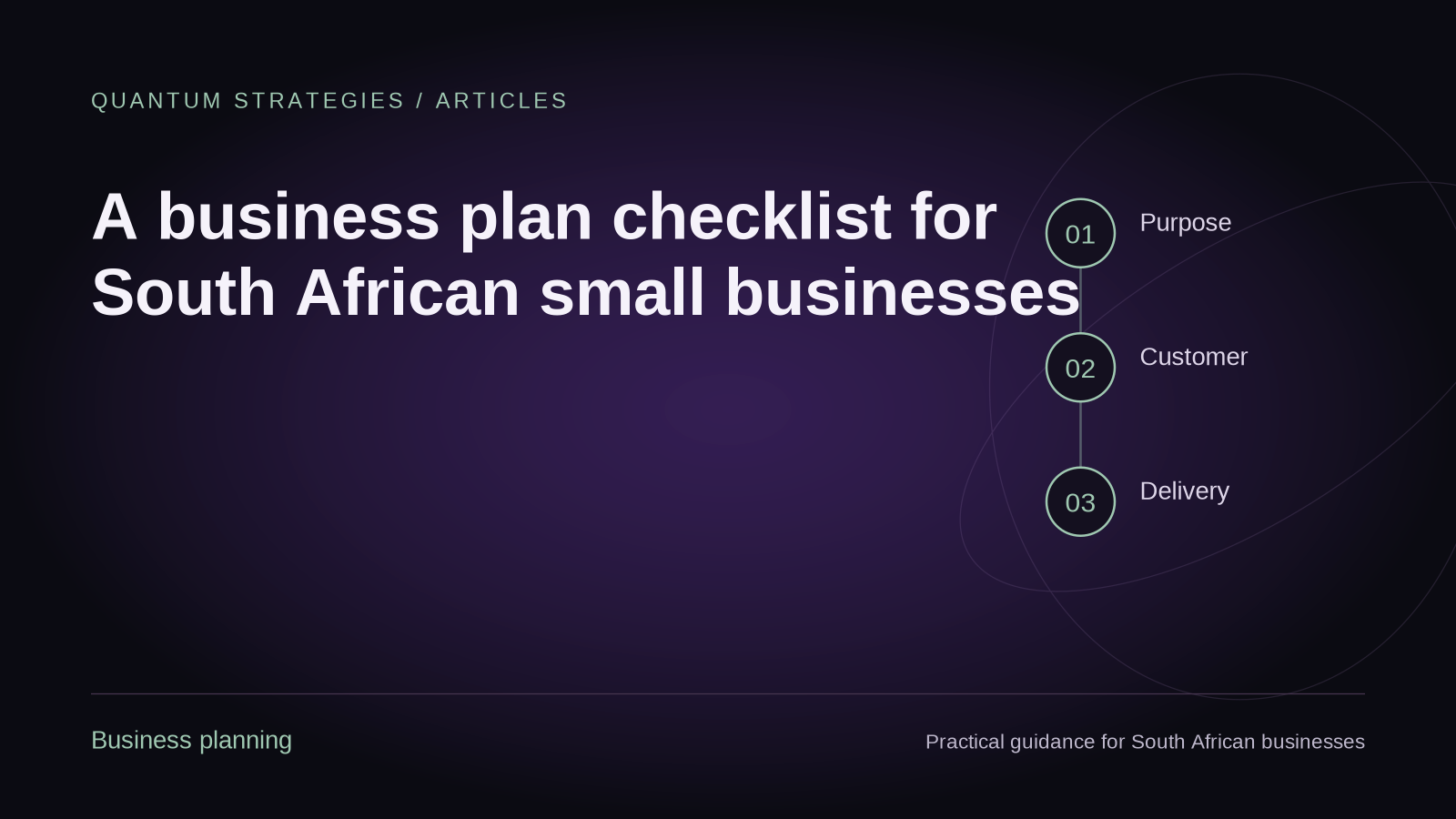
Purpose
Reader and decision
Customer
Problem and offer
Delivery
People and capacity
Finances
Assumptions and timing
Evidence
Sources and gaps
A practical preparation checklist; individual funding requirements vary.
Begin with the reader and the decision
Write down why the plan exists. An owner deciding whether to expand needs different detail from a lender assessing a particular funding request. Ask for the current requirements of the institution or partner who will read it, including financial schedules and supporting evidence.
For example, the Industrial Development Corporation’s published FAQ includes a completed business plan among its funding requirements, alongside other criteria. That does not mean the same checklist applies to every funder or that a completed plan secures approval. Check the relevant programme and eligibility before spending time preparing an application.
Explain the offer and the customer problem
Describe the product or service in terms a buyer would understand. Specify what is included, how it is delivered and why the customer would choose it. Avoid broad statements such as “everyone needs our service”. Define a reachable customer group and the situation that prompts them to buy.
Identify the alternatives, including doing the work internally or postponing it. Show the evidence you have collected and its limits. A few encouraging conversations do not establish the size of the market. Separate actual enquiries, paid orders, expressions of interest and your own assumptions.
- Customer: who makes the buying decision and who uses the product?
- Problem: what difficulty, requirement or desired result prompts a purchase?
- Offer: what precisely will the customer receive?
- Route to market: how will suitable customers find and evaluate you?
- Evidence: what supports the proposed price, demand and buying process?
Show how the business will deliver
Describe the work from enquiry to payment and after-sales support. Include people, premises where relevant, equipment, systems, suppliers and capacity. State which resources already exist and which depend on future agreements or spending. Do not present a quotation as an installed asset or a discussion as a secured supplier arrangement.
List the permissions, professional input and compliance checks relevant to the actual activity. Record who will verify them. A generic online template cannot determine all the requirements of a food operation, a professional service or an industrial project. Describe the management team accurately and distinguish employees, contractors and roles still to be filled.
Build connected financial assumptions
Prepare forecasts that explain revenue, costs, profit and cash timing. A useful sales assumption starts with a quantity and price, supported by capacity and a route to customers. Include the costs required to deliver those sales and the timing of customer and supplier payments.
The SBA’s business-planning guidance provides a general structure covering the business, market, management, offer and finances. Its US legal and funding references should not be transferred into a South African plan. Use the structure as a prompt, then adapt the detail to your business and reader.
- Start-up and expansion spending, supported by quotations where available.
- Revenue assumptions showing units, prices and realistic sales timing.
- Direct costs and operating expenses, with clear treatment of owner remuneration.
- Cash receipts and payments, including deposits, credit terms and financing.
- Alternative scenarios and the point at which the proposal needs to change.
Illustrative example: connect volume, capacity and cash
Suppose a workshop proposes selling 80 service jobs each month at R1,500 per job. Planned monthly revenue is R120,000. If each job requires three productive hours, delivery needs 240 productive hours before allowing for administration, travel or rework. These are illustrative assumptions, not a performance benchmark.
If the team can reliably provide only 180 productive hours, the sales forecast and operating plan do not agree. The owner must adjust volume, delivery time, staffing or the offer. Even after resolving capacity, invoices paid the following month will not fund all current-month costs. The cash forecast must show when receipts arrive. This cross-check is more valuable than adding another page of optimistic narrative.
Organise evidence and present the remaining gaps
Keep a dated evidence folder containing relevant quotations, research notes, financial records and agreements. Include only information appropriate to the intended recipient and use secure sharing for sensitive documents. Reference supporting material from the plan so readers can trace important claims.
Write the executive summary after the detailed work. It should state the venture, customer, delivery model, key assumptions, funding or resource need where relevant, and the decision requested. Review every total and remove contradictions between sections. Ask someone unfamiliar with the business to explain the plan back to you; their questions reveal missing context.
If you need support bringing the evidence and narrative together, explore business plan services. Use market research where customer assumptions need testing and financial consulting where forecasts need clearer logic. An enquiry is more useful when it names the intended reader, deadline and information already prepared.
Common questions
How long should a business plan be?
Long enough to support its decision and meet the reader’s requirements. Clear assumptions, coherent numbers and accessible evidence matter more than an arbitrary page count.
Can a start-up prepare a plan without past financial statements?
Yes, but projections must be labelled as assumptions and supported where possible. Explain the basis for prices, volume, capacity and costs rather than presenting estimates as historical results.
Will a professional business plan guarantee funding?
No. Funding depends on the institution’s criteria, assessment, available programmes and the venture itself. A plan helps explain the proposal; it does not guarantee a decision.
Sources and further reading
Official and specialist sources checked on 28 October 2026. Examples and diagrams in this article are illustrative.
- Industrial Development Corporation: Frequently asked questionsIDC lists a completed business plan among its funding requirements; requirements are institution-specific and approval is not guaranteed.
- US Small Business Administration: Plan your businessGeneral business-plan structure and distinction between market research and competitive analysis; US funding/legal requirements are not applied to South Africa.