What to take away
- Identify the unresolved decision before choosing a planning service.
- Connect direction to operating capacity and cash requirements.
- Record trade-offs and assumptions explicitly.
- Review evidence and decisions, not just completed documents.
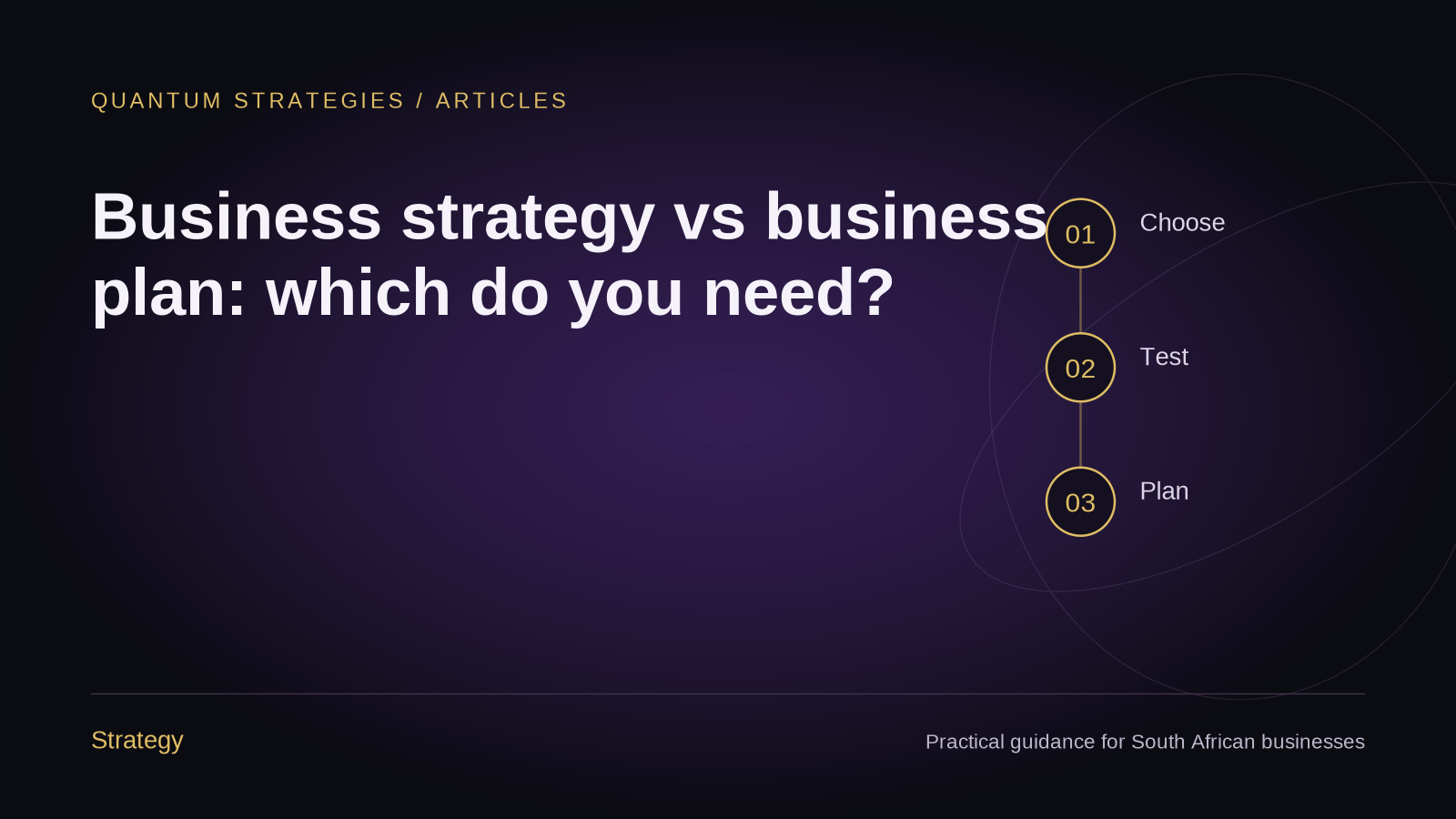
Choose
Direction and trade-offs
Test
Evidence and viability
Plan
Resources and delivery
Review
Results and assumptions
The planning tasks inform one another; this is not a compulsory document sequence.
Strategy makes choices; a business plan explains the venture
Strategy establishes a direction and the choices behind it: which customers to serve, what value to offer, where to focus resources and what to leave out. A business plan explains a business or proposed venture, including its offer, market, operations, people and financial assumptions. The BDC comparison similarly distinguishes future direction and organisational priorities from the workings and resources of a business or project.
The difference is purpose, not page count. A strategy does not become useful because it fills a presentation, and a business plan does not become credible because it contains a large spreadsheet. Each should help a reader make a decision. Some organisations combine both in one document; clear thinking still requires both sets of questions.
Identify the question you cannot yet answer
If your established business is pursuing several markets, struggling to choose investments or accepting work that distracts the team, the immediate need may be strategic. Examine customer fit, capabilities, capacity and trade-offs before forecasting every possible growth idea.
If you have chosen an offer but need to explain its operating model, resource requirements and financial assumptions, a business plan is more relevant. The reader may be an owner, partner, lender or internal manager. Confirm their requirements at the start. If you do not yet know whether the venture is viable, investigate that uncertainty through a feasibility study rather than treating a persuasive plan as proof.
| Question | Main planning task |
|---|---|
| Which customers and activities deserve our focus? | Strategy |
| How will the chosen venture operate and be resourced? | Business plan |
| Is the proposal viable under realistic conditions? | Feasibility study |
| Who will do the work next week? | Operational action plan |
Illustrative example: a business choosing its next market
Imagine a small maintenance business serving households and commercial properties. Both generate enquiries, but commercial work requires longer payment terms and more documentation. The owner cannot improve both offers immediately. This is an illustrative decision, not a client case study.
The strategic work compares the customer needs, margins, team skills and delivery requirements of each market. The owner might choose to prioritise recurring commercial maintenance, retain a limited household service and decline jobs outside a defined area. The choice includes what the business will stop promising.
A business plan then explains the selected commercial offer: service scope, sales process, staffing, scheduling, supplier costs and expected receipts. It tests whether the operating and cash requirements fit the choice. If the figures reveal an unaffordable cash gap, the team revisits the strategy or changes the rollout. Planning is a conversation between decisions and evidence, not a one-way document exercise.
Turn a direction into an executable plan
Describe the priority in ordinary language and connect it to a measurable outcome. “Become the leading provider” is difficult to act on. “Build a repeatable maintenance offer for a defined customer group” invites concrete decisions about scope, capacity and sales activity.
Give each priority an owner, an initial action, a resource allowance and a review date. Name the assumptions that could change the decision. If customer interviews reveal a different buying process, or supplier lead times increase, the response should be deliberate rather than hidden in a revised forecast.
- Choice: identify the customer, problem and offer receiving attention.
- Evidence: record what supports the choice and what remains uncertain.
- Trade-off: state which work or investment will be deferred.
- Delivery: assign responsibilities and the first practical milestones.
- Measure: define an outcome and an early signal you can review.
Keep one consistent set of assumptions
A common failure is maintaining a strategy presentation, a business plan and a budget that describe different businesses. The presentation promises a new region, the plan assumes existing staff can absorb it, and the budget contains no travel or training allowance. Reconcile the documents before seeking approval.
Use an assumptions register with a date, source, owner and confidence note. Separate signed orders from possible sales and known supplier quotations from estimates. Maintain a single current version of major figures. When assumptions change, update the decision narrative as well as the spreadsheet. A plan should explain why its numbers moved.
Use a review routine that leads to decisions
Review the plan when material evidence changes and at a cadence that suits the business. Look at what happened, why it differs from the assumption and what action follows. A missed milestone might reflect poor execution, but it can also expose an unrealistic dependency. Investigate before simply moving the deadline.
Strategy consulting suits questions about direction, positioning and priorities. Business plan services suit the work of documenting and testing an agreed venture for its intended reader. If you need help deciding where to begin, describe the choice you face and the information already available in your enquiry.
Common questions
Does every small business need two separate documents?
No. A compact combined plan may work well. Make the strategic choices, operating arrangements and assumptions easy to find, regardless of how many documents you use.
Can I write a business plan before choosing a strategy?
An early draft can reveal questions, but detailed forecasts become fragile when the target customer and offer keep changing. Resolve major choices and revise the plan as evidence improves.
How often should I revise the strategy?
Use regular reviews and revisit it when important assumptions change. The right cadence depends on the pace of change and decision risk; there is no universal timetable.
Sources and further reading
Official and specialist sources checked on 28 October 2026. Examples and diagrams in this article are illustrative.
- BDC: Business plan vs strategic planDifferent purposes of strategic and business planning; used as general management guidance, not South African funding rules.