What to take away
- Agree decision criteria before evaluating the proposal.
- Test the assumptions that could change the decision first.
- Separate break-even arithmetic from evidence of customer demand.
- Allow for a staged, revised or negative conclusion.
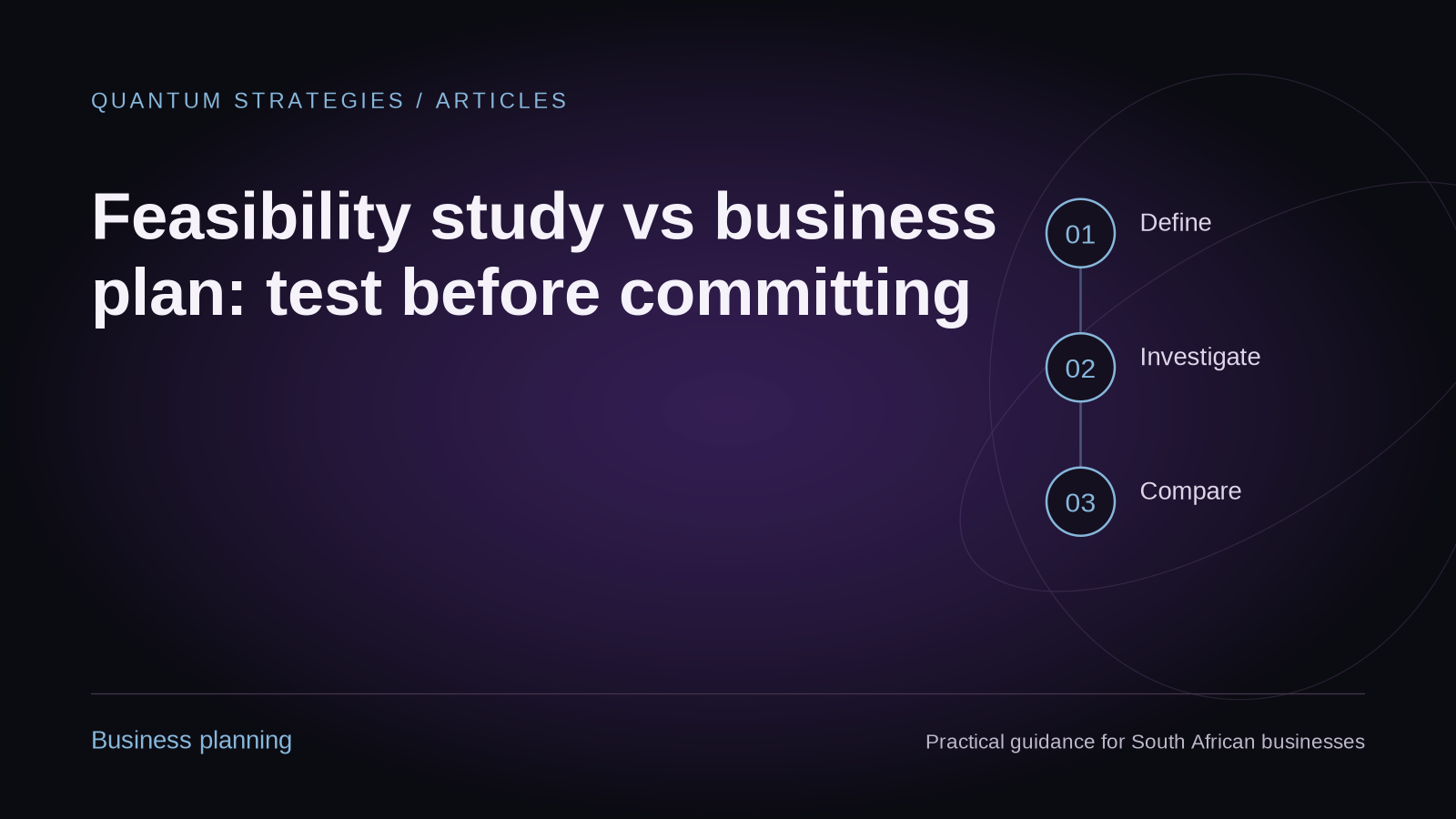
Define
Proposal and alternatives
Investigate
Critical assumptions
Compare
Scenarios and constraints
Decide
Conditions and next steps
A feasibility study may lead to proceed, revise, investigate further or stop.
Separate investigation from implementation planning
A feasibility study examines whether a proposal is viable, what might prevent it from working and which alternatives deserve consideration. A business plan explains how a chosen venture will operate and be resourced. There is overlap in market, operating and financial information, but the decision each supports differs.
Iowa State University Extension’s feasibility guidance describes feasibility as an investigation into viability and whether to proceed. It also cautions against blindly following templates. The practical implication is to investigate the uncertainties that could change your decision, rather than fill every heading with equally detailed material.
Write the decision and the alternatives
Define exactly what is being assessed. “A food business” is too broad. A proposal could involve a particular offer, delivery area, production method and customer group. Record the alternatives, including a smaller pilot, outsourced production, a different site or postponement.
Agree what a favourable result would mean before commissioning the work. Criteria may include a workable production method, sufficient evidence of customer willingness to pay, an affordable cash requirement and acceptable operational risk. Avoid choosing a threshold simply because the first forecast happens to meet it. The criteria should reflect the owner’s resources and the requirements of other decision-makers.
Investigate the questions that could stop the project
Start with the assumptions carrying the most uncertainty and consequence. If a site cannot support the intended activity, a detailed social-media plan adds little value. If customers will not pay enough to cover the delivery model, an attractive premises layout does not resolve the problem.
Use methods suited to each question. Customer interviews explore needs and buying processes; supplier quotations help test costs; technical assessment investigates practical constraints. Where specialist legal, environmental or technical requirements apply, identify the responsible professional and the evidence required. A general feasibility report cannot substitute for every specialist approval.
- Market: who would buy, why, at what price and through which process?
- Delivery: can the offer be produced consistently with available people and systems?
- Financial: what costs, cash requirements and sensitivities arise?
- Resources: which skills, suppliers, premises and approvals are dependencies?
- Risk: what could materially change the decision and how could it be tested?
Illustrative example: a proposed delivery service
Imagine an owner considering a local delivery service with two options: buy a vehicle immediately or run a limited pilot using a contracted provider. This is an illustrative scenario, not a Quantum client result.
The initial assumption is 100 deliveries a month at R150 each, producing R15,000 revenue. At an assumed R90 variable cost per delivery, the amount remaining before fixed costs is R6,000. If fixed monthly costs are R9,000, the simplified model has a R3,000 shortfall. At unchanged prices and costs, 150 deliveries would cover those fixed costs, because R9,000 divided by R60 is 150.
That arithmetic does not establish demand for 150 deliveries. Nor does it include every possible tax, financing or capital cost. The next questions concern achievable volume, route density, service quality and payment timing. A pilot could help test some assumptions, while a vehicle purchase would create a larger commitment before those questions are answered.
Use scenarios and state uncertainty plainly
Show how the conclusion changes when an important assumption changes. Lower sales, a longer launch period or higher supplier costs may reveal that a proposal only works under narrow conditions. Avoid treating the most attractive scenario as the expected result simply because it supports the preferred decision.
For each major assumption, record the source, date, confidence and next verification step. Distinguish measured facts from estimates and expressions of interest from orders. If evidence is insufficient, “more information needed” is a legitimate conclusion. So are proceeding in stages, changing the model or stopping. A commissioned study should not be expected to produce a positive verdict.
Turn findings into a decision record
A useful conclusion explains the options considered, evidence reviewed, assumptions that matter and conditions attached to proceeding. List unresolved dependencies and assign an owner to each. Keep the decision record brief enough to revisit when circumstances change.
If the proposal passes the agreed checks, transfer its validated assumptions and remaining conditions into the business plan. Preserve the source references so the plan does not turn a tentative estimate into an apparent fact. Revisit feasibility when major conditions change rather than relying indefinitely on an old report.
Explore feasibility studies when the question is whether and how far to commit. Business plan services can then help document the selected venture, while market research can address specific customer uncertainties. Start your enquiry with the proposed decision, alternatives and commitments you are considering.
Common questions
Is a feasibility study always required before a business plan?
No. The depth of investigation should match the uncertainty and consequences. A small reversible experiment may need a brief assessment; a costly or technically complex project can require specialist studies.
Can one report include both?
Yes, if it clearly separates viability findings from the implementation plan. Readers should be able to see what was tested, what remains assumed and why a particular option was chosen.
What if the study recommends stopping?
That can be a useful result if the evidence is sound. Examine whether the issue can be resolved through a different scope or model, and avoid further commitments solely because money has already been spent.
Sources and further reading
Official and specialist sources checked on 28 October 2026. Examples and diagrams in this article are illustrative.
- Iowa State University Extension: What is a feasibility study?Feasibility investigates viability and whether to proceed; scope should fit the proposal rather than blindly follow a template. Published July 2020, checked current accessibility.