What to take away
- Measure each stage using its own definition.
- Use consistent campaign links and verified enquiry records.
- Explain attribution limits and make one evidence-based next decision.
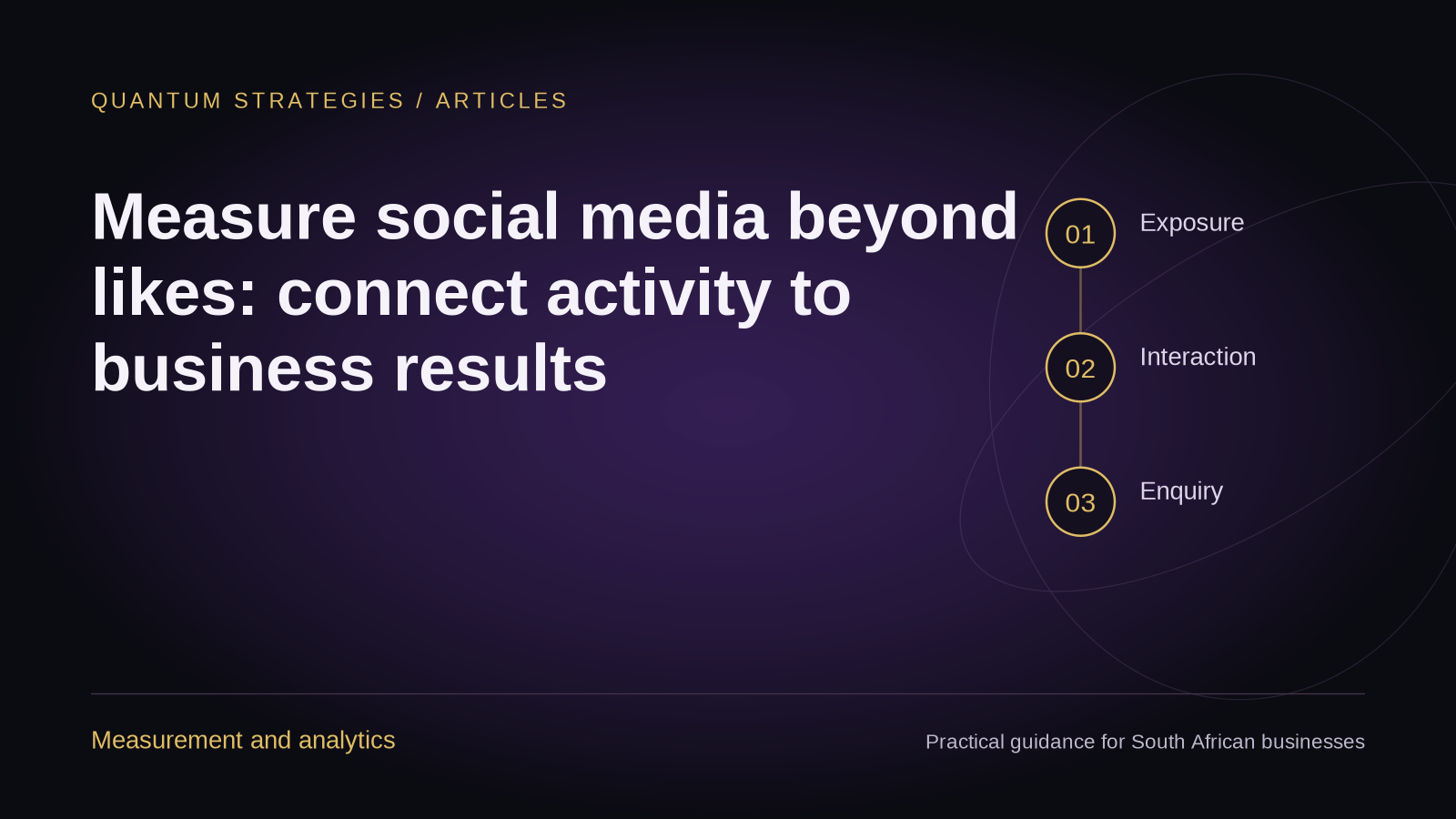
Exposure
Content shown
Interaction
Response or click
Enquiry
Accepted request
Outcome
Qualified need and recorded result
Illustrative measurement layers, not a guaranteed linear customer journey.
Choose the business question before the metric
Ask what the content is meant to support. A practical guide may help prospects understand a service. A course overview post may encourage an access enquiry. A customer-service update may reduce confusion. Each purpose needs a different interpretation of the response.
Write the question at the top of the report. “Did the course posts produce relevant enquiries?” directs attention to the destination and enquiry records. “Which topics prompted useful questions?” requires reviewing the nature of the response, not just counting reactions.
Keep exposure and engagement in their place
Platform definitions differ, so use the metric description for the account and report you are viewing. LinkedIn, for example, distinguishes impressions, members reached, clicks and engagement. Its Page content clicks can include clicks on the company name or logo, not only a visit to your website.
Do not add reach across platforms and present the sum as unique people. The same person may appear in several audiences. Likewise, a reaction or comment may come from a colleague, an existing customer or someone with no current buying need. These actions are signals to interpret, not verified leads.
| Level | Example measure | Useful limitation |
|---|---|---|
| Exposure | Impressions or platform reach | Definitions and deduplication vary |
| Interaction | Comments, reactions or clicks | Interaction is not necessarily purchase intent |
| Website activity | Tagged visits to the destination | Some activity may not be measurable |
| Enquiry | Accepted request or recorded conversation | Relevance still needs assessment |
| Business outcome | Qualified lead, agreed work or payment | Requires operational evidence |
Use campaign links deliberately
Google Analytics supports UTM parameters to identify campaigns referring traffic. Use a consistent naming scheme for source, medium and campaign, with content identifiers where useful. Keep the names descriptive of the campaign or post, not the person who clicks.
For example, a fictional campaign could use a platform name as source, social as medium and a course-introduction label as campaign. Test the full destination link before publishing. Do not put an email address, customer name or private enquiry reference in a tracking URL. Keep internal website navigation separate from external campaign tagging.
Verify the next step after the visit
Check whether the destination offers the action promised by the post. If the aim is an enquiry, test the form or contact route. Distinguish a click on the contact button from a successful submission and from a conversation that staff have assessed as suitable.
Create an operational method for recording source information when it is known, including an “unknown” option. A voluntary answer to “How did you hear about us?” can provide context, but it is not a complete attribution system. Avoid forcing staff to guess a channel to make the report look complete.
Worked example: compare two posts without declaring a winner
Imagine two fictional posts. Post A receives 100 reactions, 20 measured website visits and one recorded enquiry. Post B receives 20 reactions, 35 measured visits and three recorded enquiries. The second post may deserve further investigation for the enquiry objective even though it attracted fewer reactions.
Before calling it better, check the audience, promotion spend, publication period, offer and enquiry quality. Three enquiries are a small number, and some people may have seen both posts. These figures illustrate a review question; they are not client results or a benchmark for your content.
Define rates and costs with their denominators
A rate should state what is divided by what. A platform engagement rate and a website enquiry rate usually measure different actions against different totals. Do not compare them as if they describe the same stage.
For cost per qualified lead, divide the relevant campaign cost by the number of leads meeting your agreed qualification definition, using a consistent period and scope. State whether cost includes only media spend or also production and staff time. If there are no qualified leads, report the cost and zero leads rather than a misleading cost-per-lead figure.
Treat attribution as evidence with limits
A customer can see content, search for the business later, ask a colleague and then enquire by phone. One system may credit the final measurable visit while another uses a different reporting rule. Neither view automatically describes the whole decision.
Keep platform reports, website analytics and operational records alongside one another. Record differences in dates, attribution settings and measurement coverage. Do not promise exact attribution when the underlying journey is partly unobserved. Use the evidence to decide what to test next rather than to construct a falsely precise story.
Turn the report into one practical decision
At each review, choose what to continue, change or stop. A strong interaction rate with weak website visits may prompt a clearer next step. Visits without enquiries may prompt a landing-page or form check. Enquiries without service fit may prompt a clearer explanation of scope.
Quantum Strategies’ marketing consulting can help scope this review. The Social media, made simple and Understanding Google Analytics 4 course overviews provide learning options for the content and website-reporting parts of the journey. Keep course learning, platform activity and actual business outcomes as distinct records.
Common questions
Are likes a useless metric?
No. They can help describe interaction with content, provided they match the question being asked. They become misleading when reported as proof of leads, sales or profit.
Should social media numbers match GA4 exactly?
No. Platforms and website analytics measure different actions and may use different coverage and attribution rules. Investigate material changes, but do not assume every difference is a tracking fault.
Sources and further reading
Official and specialist sources checked on 28 October 2026. Examples and diagrams in this article are illustrative.
- LinkedIn: Content analytics for your PageDefinitions of impressions, reached members, Page content clicks and engagement; metrics differ from website visits.
- Google Analytics: Collect campaign data with custom URLsUTM source, medium, campaign and content fields for campaign traffic. Example naming and worked figures are original.