What to take away
- Train the stage of the process that needs improvement.
- Practise listening, accurate scope and appropriate next steps.
- Review behaviour and business results without confusing the two.
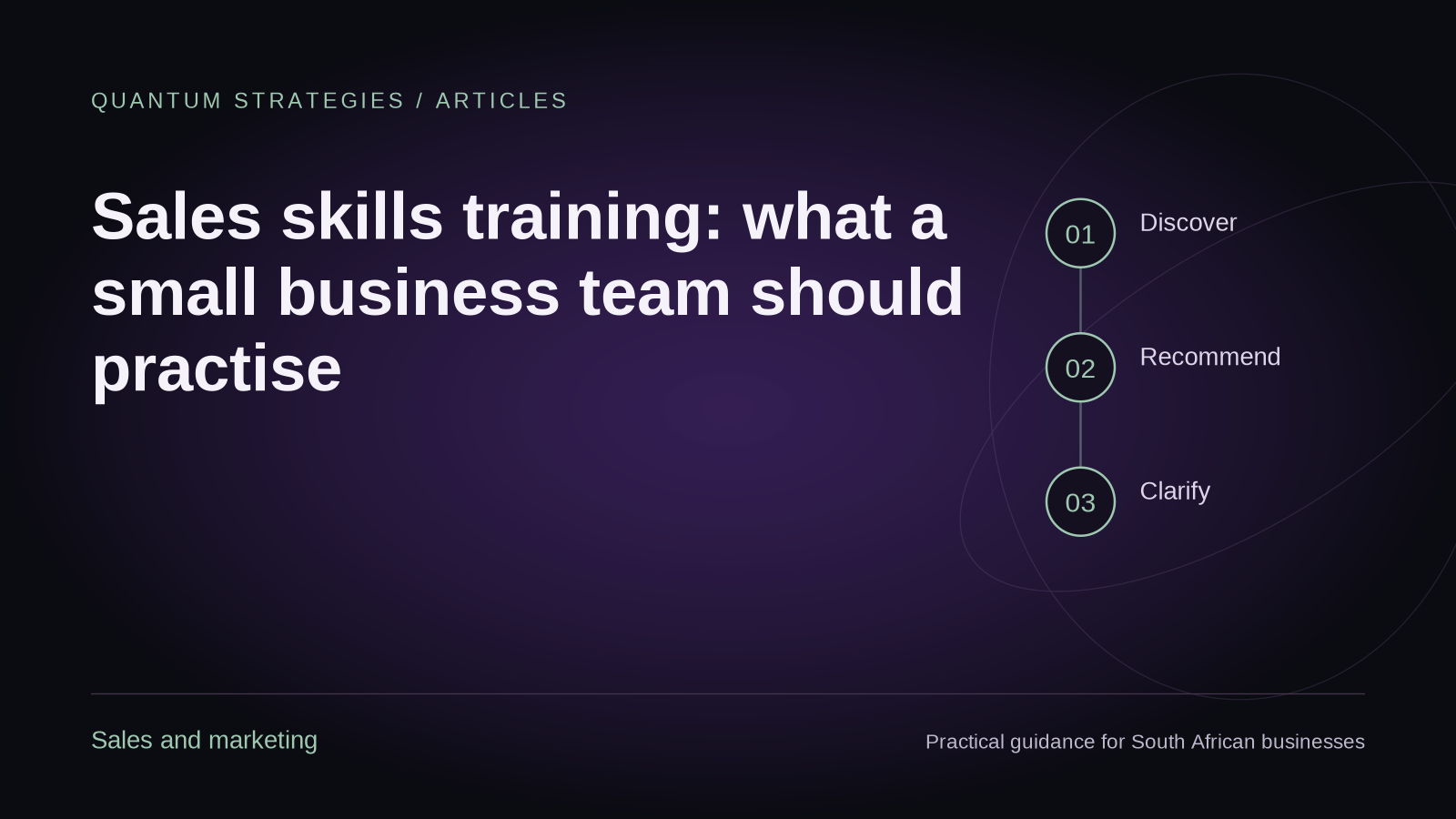
Discover
Understand the actual need
Recommend
Explain verified fit
Clarify
Resolve gaps and concerns
Agree
Record the next step
Original illustrative practice sequence; it does not guarantee a sale.
Identify the part of the sales process that needs work
Map the path from first enquiry to agreed work: initial response, discovery, recommendation, quotation, follow-up and handover. Look at a sample of recent opportunities. Where does information go missing? Where do customers hesitate? Where are expectations later corrected by the delivery team?
Keep the diagnosis open. A low win rate may involve price, product fit, lead quality, delivery capacity or response time as well as sales skill. Training is appropriate when there is an identifiable behaviour to improve. It should not become a convenient explanation for every lost opportunity.
Practise discovery before practising the pitch
Salesforce’s own sales-learning material emphasises questions and active listening in discovery. Apply that principle by asking about the customer’s situation before presenting an offer. The aim is to understand the task, constraints and decision process, not to collect a script’s worth of answers.
For example, a supplier might ask what must be delivered, what would make the work successful, what has already been tried and who needs to approve the decision. Summarise the answer and invite correction. Avoid asking for sensitive or irrelevant information simply because it might make a customer easier to persuade.
- What problem are you trying to solve?
- What is making the current approach difficult?
- What does the work need to include or exclude?
- What timing or practical constraints should we understand?
- What would help you make a well-informed decision?
Turn product knowledge into a relevant recommendation
Train people to connect a verified feature or service component to the need just discussed. If the customer needs a documented handover, explain the actual handover material included in the proposed scope. Do not substitute an unsupported claim such as “we will transform your business”.
Practise identifying poor fit as well as good fit. A salesperson should know which requests need specialist input, which promises require approval and which work the business cannot deliver. Honest limits protect the customer relationship and help the delivery team understand what has been sold.
Make proposals clear enough to compare
Use a proposal exercise that requires the learner to state the problem, proposed scope, assumptions, responsibilities, price basis and next step. The exercise should include a missing fact that must be clarified rather than guessed.
Practise explaining scope changes and concerns without automatically discounting. “The two options include different delivery support; let us compare what you need” is a more useful discussion than treating every question as an objection to overcome. Any legal or financial commitments in the final proposal need the appropriate authorised review.
Use a role-play with observable behaviours
The following scorecard is an illustrative training tool. It is not a prediction of conversion rate. Give the customer role enough information to make the conversation realistic, including a request the salesperson should not promise immediately.
| Behaviour | What the observer looks for |
|---|---|
| Clarifies the need | Asks relevant questions and checks understanding |
| Explains fit | Connects verified scope to the customer’s requirement |
| Handles uncertainty | Identifies missing facts without inventing answers |
| Agrees next step | Confirms an owner, action and appropriate timing |
| Records the conversation | Leaves a useful, factual handover note |
Worked example: an enquiry about business training
In a fictional training business, a customer asks for “a course for everyone”. The salesperson practises asking which task needs improvement, who performs it and what the team already knows. The customer explains that supervisors struggle to give clear feedback.
The learner should summarise that need, explain the relevant training approach and identify the information required to scope delivery. They should not promise that attendance will resolve every performance issue. A useful next step might be a scoped discussion with the person responsible for the programme. The observer then gives feedback on specific moments in the conversation.
Connect training to everyday management
After practice, choose one behaviour for the salesperson to apply during normal work. Review appropriate notes or work samples with the person’s knowledge and within your privacy arrangements. Include the quality of the handover, not just whether an order was won.
Use business measures carefully. Track agreed next steps, proposal completeness and follow-up quality alongside qualified opportunities and sales. Changes in customer mix or pricing can affect results, so do not claim that training alone caused a revenue change.
Quantum Strategies’ sales training service can help scope practical sales-development needs. Marketing consulting is relevant when the underlying problem is the offer or the enquiries entering the process; operations consulting can address the handover after the sale.
Common questions
Should everyone follow the same sales script?
A shared conversation structure can help, but a rigid script may miss important customer information. Practise the purpose of each stage and allow relevant follow-up questions.
How should we assess sales training?
Use an agreed behaviour scorecard, a practical exercise and a later review of work. Keep attendance, demonstrated skills and commercial results as separate measures.
Sources and further reading
Official and specialist sources checked on 28 October 2026. Examples and diagrams in this article are illustrative.
- Salesforce Trailhead: Close more deals with soft skillsDiscovery questions and active listening. No Salesforce performance claims, scripts or client examples are reused.