What to take away
- Profit measures performance; cash flow measures money movement.
- Trace invoices and receipts across periods without double-counting revenue.
- Separate loans, asset purchases and owner movements from trading.
- Diagnose whether the problem is margin, timing or both.
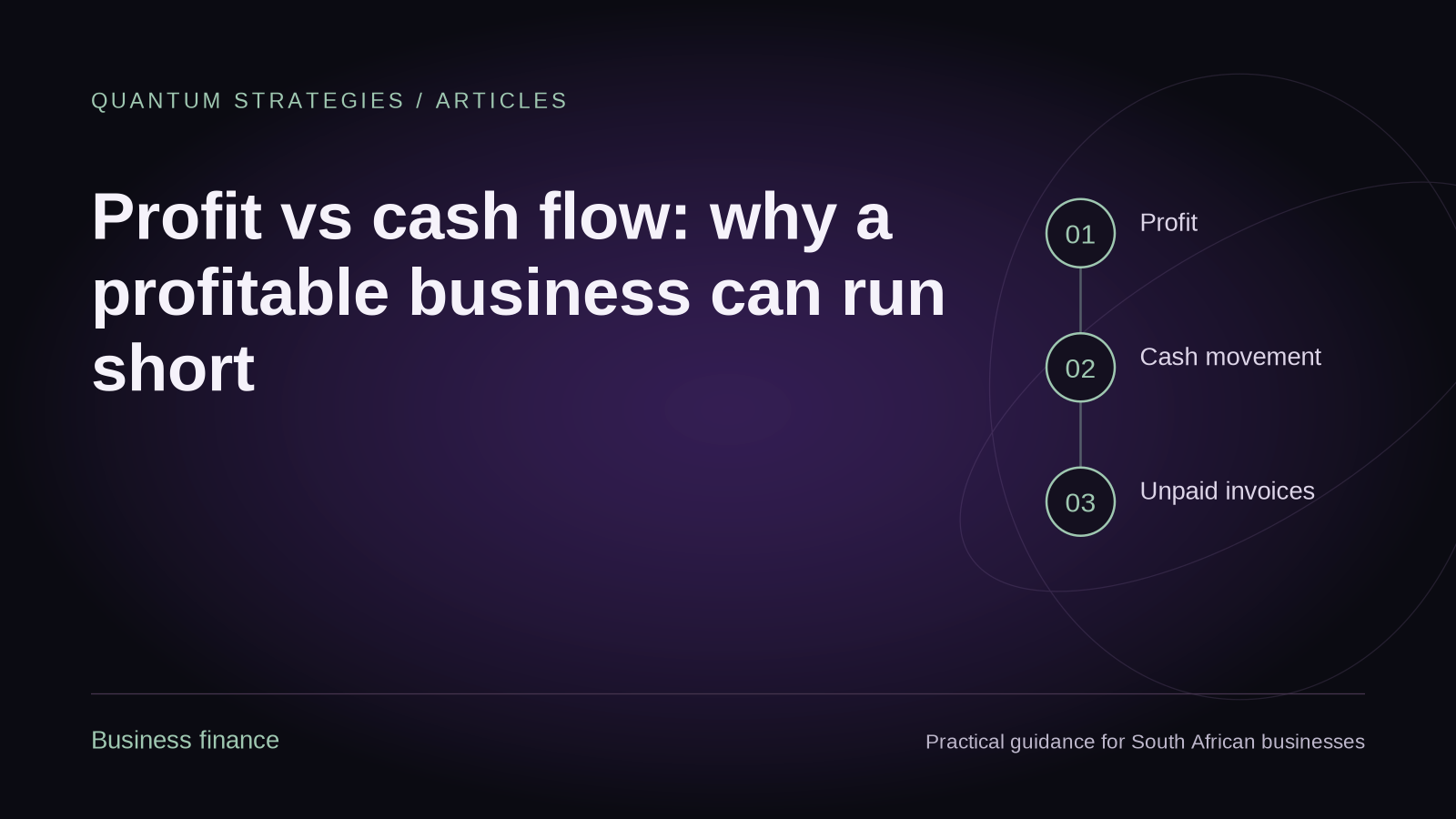
Profit
R10,000 for the period
Cash movement
−R40,000 for the period
Unpaid invoices
R50,000 still to collect
Illustrative simplified accrual example; excludes tax and other movements.
Understand what each measure answers
Profit compares recognised revenue with the expenses associated with a period under the accounting basis used. Cash flow records money received and paid. In accrual accounts, revenue and expenses can appear before the corresponding cash movement. Ask your accountant which basis your reports use so that you interpret them consistently.
Xero’s South African cash-flow guide explains the distinction and separates operating, investing and financing movements. The useful management question is not which measure matters more. It is what each reveals that the other cannot: trading performance, payment timing and the source of changes in the bank balance.
Illustrative example: a sale paid next month
Imagine a service business completes and invoices R80,000 of work in a month. It incurs R50,000 in direct costs and R20,000 in operating expenses. For this simplified accrual example, all revenue and expenses belong to that month, customers pay R30,000 during the month, and the remaining R50,000 is due later. All R70,000 of costs are paid now. Taxes, depreciation and other movements are excluded solely to keep the example clear.
The business reports a R10,000 profit: R80,000 less R70,000. Its cash movement from these transactions is negative R40,000: R30,000 received less R70,000 paid. With R25,000 opening cash, that would produce an unfunded R15,000 gap. The example is illustrative and does not suggest that a bank would permit the shortfall.
| Measure | Calculation | Result |
|---|---|---|
| Profit for the period | R80,000 revenue − R70,000 expenses | R10,000 |
| Cash movement | R30,000 receipts − R70,000 payments | −R40,000 |
| Forecast closing cash | R25,000 opening cash − R40,000 | −R15,000 |
Follow the unpaid amount into the next period
When the remaining R50,000 is received, cash increases. The same sale should not become revenue a second time in accrual accounts merely because payment arrived. It was already recognised when earned under the applicable accounting treatment.
This is why comparing one month’s sales directly with one month’s bank receipts can be misleading. Receipts may relate to earlier invoices, while current invoices may remain outstanding. Review the aged receivables report alongside the bank reconciliation and investigate overdue or disputed amounts. A receivable is not equally useful as cash if there is uncertainty about collecting it.
Recognise other movements that separate profit and cash
Stock, equipment and financing can create further differences. Buying stock uses cash, but unsold stock is generally recorded as an asset rather than immediately becoming the cost of goods sold. Equipment purchases may be recognised as assets, with expense recognition over time according to the applicable accounting treatment. Get professional help with classification rather than coding every bank payment as an operating expense.
A loan receipt increases cash and a liability; it is not sales revenue. Repaying loan principal reduces cash and the liability, while interest is accounted for separately. Owner contributions and withdrawals also need appropriate treatment. These distinctions make a reconciled set of reports more informative than a bank balance alone.
Diagnose the problem before choosing the response
If profit is weak, examine prices, costs, sales mix and overheads. Faster collections may provide breathing room, but do not repair an offer that consistently costs more to deliver than it earns. If trading is profitable but cash is tight, investigate payment terms, slow stock, deposits, capital spending and financing timing.
Sometimes both problems exist. Discounting to bring in quick cash may reduce already thin margins. Accepting a large order may improve reported sales while increasing the cash needed to deliver it. Evaluate the whole transaction before celebrating revenue growth.
- Profit question: does the offer cover its direct costs and share of overheads?
- Collection question: when will customers actually pay, and what could delay them?
- Stock question: how much cash is tied up before a sale happens?
- Commitment question: what payments are due before receipts arrive?
- Financing question: how much of the balance came from borrowing or owner funding?
Use a small set of connected reports
Review a current profit-and-loss statement, balance sheet, aged receivables and payables, and a rolling cash forecast. Reconcile them to the accounting records. The aim is to connect trading results, outstanding amounts and expected cash movements, not create a larger reporting pack.
Ask for explanations of significant differences. If sales rose but cash fell, trace the change through receivables, stock, spending and financing. If cash rose, check whether that came from customers, a loan or delayed supplier payments. Different causes require different decisions.
Financial consulting can help organise business reporting and cash assumptions. For the practical next step, use the cash-flow forecast guide. This article provides business education; transaction-specific accounting, tax or regulated financial advice requires the appropriate professional and agreed scope.
Common questions
Can positive cash flow hide a loss?
Yes. Borrowing, owner contributions, asset sales or collecting older invoices can increase cash while current trading loses money. Identify the source of receipts before interpreting the balance as evidence of profitability.
Does an unpaid invoice count as profit?
Under accrual accounting, recognised revenue may contribute to profit before payment, subject to the applicable accounting treatment and recoverability. Profit also depends on expenses; the invoice amount alone is not profit.
Which should I monitor first when money is tight?
Check immediate cash obligations and expected receipts promptly, while also investigating whether trading is profitable. Short-term cash action and longer-term profitability analysis often need to proceed together.
Sources and further reading
Official and specialist sources checked on 28 October 2026. Examples and diagrams in this article are illustrative.
- Xero South Africa: Cash flowCash movement differs from accounting profit; cash flows include operating, investing and financing activities.