What to take away
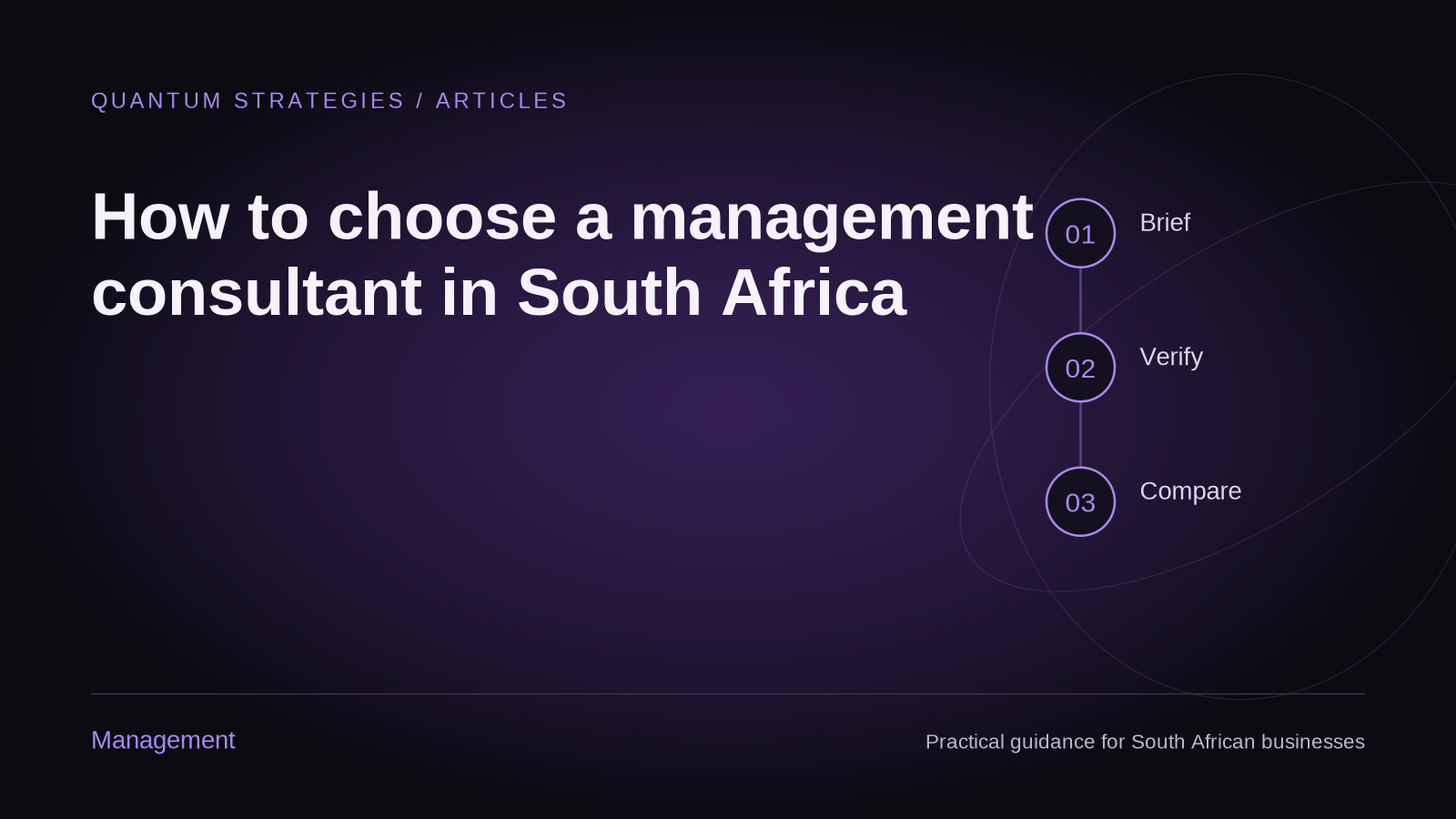
- Write one brief for every shortlisted provider.
- Verify the delivery team and evidence behind claims.
- Compare outputs, dependencies and exclusions before fees.
- Use a clear review point before expanding the engagement.
Brief
Name the decision
Verify
Check team and evidence
Compare
Match scope and effort
Agree
Set terms and ownership
Review
Assess the first stage
A purchasing framework, not a guarantee of consulting results.
Define the decision before comparing providers
Write a short buying brief before arranging introductory calls. Describe the situation, its consequences and the decision you need help making. Include the people affected, the information available and any practical deadline. “Improve our business” leaves every consultant free to propose a different project. “Understand why accepted orders miss their promised delivery dates and agree responsibilities across sales and operations” creates a more useful comparison.
Avoid prescribing a solution too early. You may think you need software when the underlying issue is an unclear approval rule. Ask providers how they would test your explanation. Also identify who in your business can make decisions and release staff time. A consultant cannot complete meaningful work if access and ownership remain unresolved.
Check who will actually do the work
Ask for the names and roles of the people assigned to the engagement. Distinguish the person selling the project from the people conducting interviews, analysing records and supporting implementation. If contractors or specialist advisers are involved, establish who supervises them and who is accountable for the final deliverables.
Request relevant examples that show the kind of problem addressed, the consultant’s role and the work produced. Confidentiality may prevent public client details; an anonymised sample can still demonstrate the quality of thinking. Seek permission before contacting references. Verify any claimed professional membership or qualification through the issuing body rather than relying only on a logo.
The IMCSA professional code emphasises suitable competence, impartial recommendations, realistic benefits and clear arrangements with clients. These provide useful questions for due diligence; citing the code does not establish that a particular provider is a member.
Compare deliverables, responsibilities and exclusions
Put proposals side by side using the same headings. A diagnostic report, a workshop and implementation support are different purchases even if they share the same project title. Ask what you will receive, in what format, and how you can tell whether each item is complete.
Clarify what your own staff must supply. Data cleaning, scheduling interviews, approving decisions and changing procedures all take time. If the proposal assumes that you will do this work, include it in the comparison. Confirm how additional requests are priced and approved before they become extra fees.
- Purpose: which decision or operating problem will the work address?
- Outputs: what documents, analysis, workshops or procedures will be delivered?
- Acceptance: who reviews each output and what makes it usable?
- Dependencies: which records, staff and decisions must your team provide?
- Exclusions: which specialist matters and implementation tasks sit outside the fee?
- Handover: what explanation, editable files and follow-up are included?
Illustrative example: compare two delivery proposals
A small wholesaler wants to understand repeated delivery delays. Provider A proposes a two-week review and a findings presentation. Provider B proposes a review, a revised order-handover procedure and two supported team reviews. These are illustrative proposals, not Quantum prices or client results.
Neither offer is automatically better. If the owner has a capable operations manager, the first may provide enough independent analysis. If nobody can translate findings into everyday routines, the second may fit better. Ask both providers to explain their assumptions about staff availability and access to order records. Compare the total work required to reach the intended result, not simply the daily rate.
Discuss fees, confidentiality and conflicting interests
Ask whether fees are fixed, time-based or tied to agreed stages, and what could change the total. Confirm the treatment of travel, third-party software, taxes and additional meetings in the written quotation. There is no useful universal consulting price without knowing the scope.
Agree how sensitive information will be shared, who can access it and what happens to copies at the end. Ask whether recommended systems or suppliers create a financial interest for the consultant. A commercial relationship does not automatically invalidate a recommendation, but it should be visible before you rely on it. Keep access proportionate: an initial diagnostic rarely needs unrestricted access to every account.
Start with a reviewable stage
For an uncertain problem, consider a bounded first stage with a clear review point. The output might be an evidence summary, prioritised issues and options for further work. Decide in advance who will review it and what information is needed to continue, change direction or stop.
Agree how success will be assessed without demanding a guaranteed revenue result. Baseline measures, completed deliverables and observed operating changes provide different kinds of evidence. Management consulting can help with issues spanning teams and responsibilities. If the need is already a defined workflow, operations consulting may be the more direct enquiry. Send the decision, current difficulty and available information when you contact Quantum Strategies.
Common questions
Should I choose the cheapest proposal?
Compare equivalent scope and total effort first. A smaller fee can be appropriate for a focused assignment, but missing implementation, data preparation or travel costs can change the comparison.
Must a consultant have worked in my industry?
Relevant sector experience can help, especially where specialist rules or operating conditions matter. Also examine problem-solving experience, methods, references and how the provider will identify limits to their expertise.
Can I request a small first project?
Yes. A defined diagnostic or workshop can test working fit, provided it produces something useful and has clear boundaries. Agree any later work separately.
Sources and further reading
Official and specialist sources checked on 28 October 2026. Examples and diagrams in this article are illustrative.
- IMCSA Professional Code of EthicsProfessional competence, independence, realistic benefits, conflicts, engagement arrangements and confidentiality.