What to take away
- Choose support by the work required, not the title alone.
- Clarify who thinks, advises, decides and implements.
- Agree progress measures and confidentiality before starting.
- Rescope when the engagement reveals a different need.
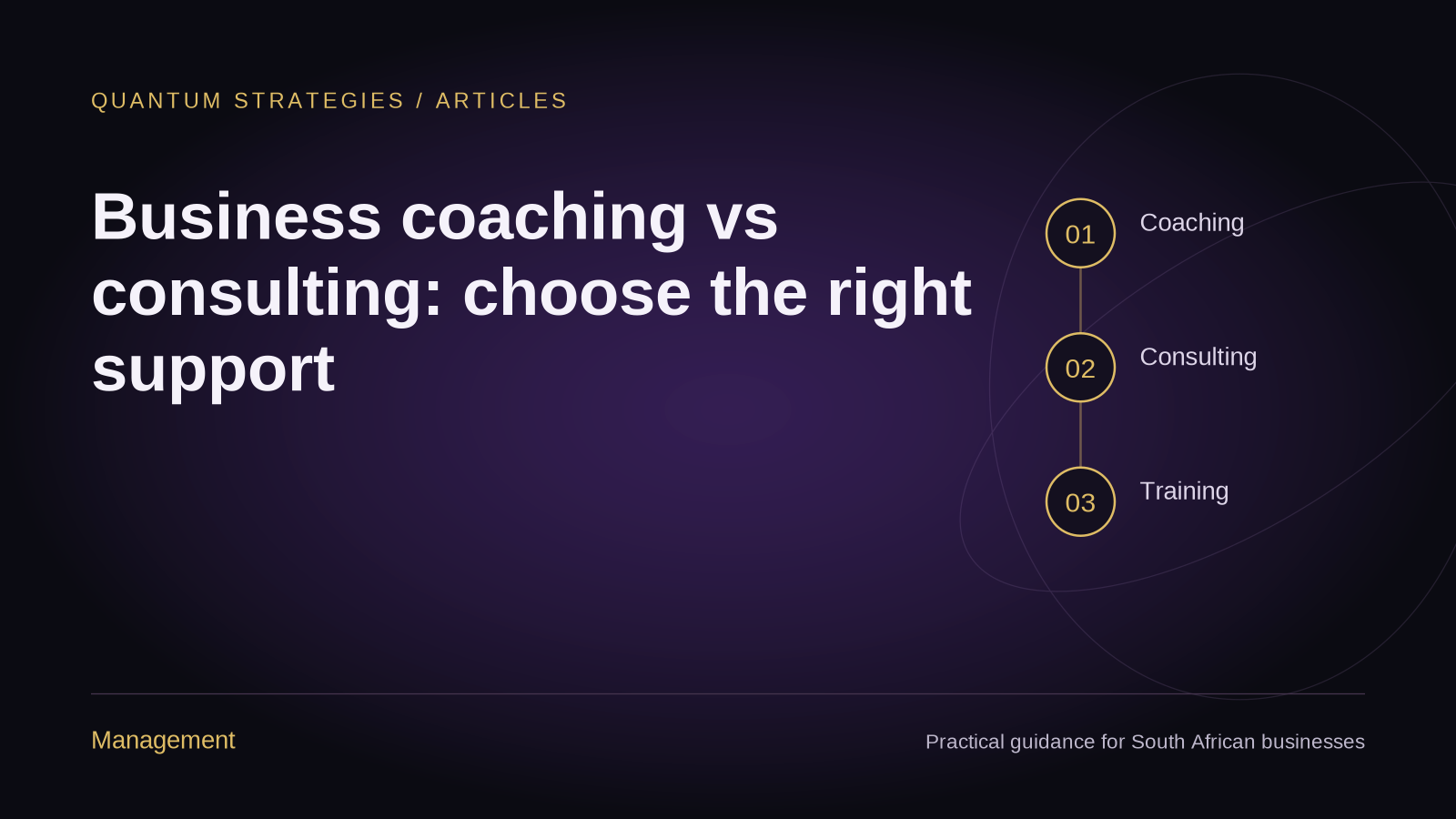
Coaching
Thinking and accountability
Consulting
Analysis and agreed outputs
Training
Specific knowledge and skills
Roles can be combined when the agreement makes the boundaries clear.
Understand the main difference in the work
Coaching commonly centres on the client’s thinking, goals, choices and accountability. Consulting commonly involves investigating an organisational problem and contributing analysis, advice or defined deliverables. In practice, an engagement may contain elements of both, so the written scope matters more than the label.
The International Coaching Federation’s ethics guidance describes coaching as a collaborative partnership and calls for clear agreements about the engagement. The IMCSA professional code addresses matters such as competence, impartial recommendations and agreed client arrangements in consulting. These are reference points for evaluating providers, not claims that Quantum holds membership or credentials from either body.
Match the support to the unresolved need
Coaching may fit when you understand the business context but need a structured conversation to examine assumptions, decide priorities and follow through. The coach does not take over ownership of your decisions. You should understand how sessions connect to the work you do between them.
Consulting may fit when the business needs an investigation, specialist analysis or a tangible output. Examples include diagnosing cross-team problems, developing a business plan or documenting a workflow. The consultant’s responsibilities, access requirements and deliverables should be explicit. Some assignments also need specialist professional advice outside either general category.
| Need | Likely starting discussion |
|---|---|
| Clarify my priorities and follow through | Business coaching |
| Investigate recurring problems across teams | Management consulting |
| Produce a defined plan or process | Relevant consulting service |
| Learn a specific practical skill | Training or a course |
| Resolve a regulated or specialist matter | Appropriately qualified professional |
Illustrative example: an owner struggling to delegate
Imagine an owner personally approving every quotation, answering routine staff questions and working late to complete decisions. A coaching conversation might explore why delegation feels difficult, which decisions the owner is willing to release and what behaviour they will practise. This is an illustrative scenario, not a client outcome.
Consulting might investigate the approval workflow, identify missing decision rules and help document responsibilities. Training might help the team apply the new process. These are complementary tasks, but they produce different outputs and require different evidence of progress.
A coaching session cannot by itself establish that a new approval procedure is technically sound. A consultant’s procedure will not automatically change the owner’s habits. If both kinds of support are needed, define them separately within the engagement and explain how they connect.
Ask what progress will look like
For coaching, agree the goals, review points and how you will reflect on progress. Useful evidence could include decisions made, actions completed and changes the client observes in relevant working practices. Avoid treating attendance at sessions as the same thing as progress.
For consulting, define outputs and acceptance criteria. A workflow map, diagnostic report or implementation plan can be reviewed for completeness and practical use. Business outcomes may depend on implementation, staff participation and external conditions. Neither coaching nor consulting should be sold as a guaranteed revenue increase without a credible basis.
- Purpose: what decision, capability or organisational problem is being addressed?
- Method: what happens during meetings and between them?
- Responsibility: who investigates, decides, produces work and implements changes?
- Evidence: how will useful progress be recognised and reviewed?
- Boundaries: which specialist issues, tasks and outcomes are excluded?
Clarify confidentiality, sponsorship and fees
If an employer pays for coaching, agree what information will be shared with the sponsor and what remains within the coaching relationship. Do not assume confidentiality arrangements are obvious. Where several people participate, discuss records, consent and access before sensitive information is disclosed.
Confirm session frequency, duration, cancellation arrangements, fees and the treatment of additional work. For consulting, clarify whether workshops, analysis and follow-up are included. Ask who will deliver the service and verify any claimed credentials with the relevant issuer. A title on a profile does not explain competence or the permitted scope of advice.
Make blended support explicit
A provider may shift from asking reflective questions to recommending a solution. That can be useful when agreed, but the change in role should be clear. The client needs to know whether they are exploring their own judgement, receiving professional advice or commissioning additional work.
If an engagement reveals a different need, pause to rescope rather than allowing responsibilities to drift. For example, a coaching discussion about cash pressure may reveal a need for financial analysis. Agree who will perform that work and the appropriate professional boundaries. Coaching should not be presented as a substitute for legal, medical or regulated financial advice.
Prepare for an initial conversation
Describe the situation, what you have already tried and what useful help would look like. If you are unsure whether you need reflection, analysis or implementation, say so. A sensible first conversation should clarify the work before committing you to a long programme.
Explore business coaching for structured support around owner and leadership decisions. Management consulting is relevant to organisational diagnosis and responsibilities. If the need is a specific skill, consider training and development. Confirm the arrangement and review points through an enquiry rather than assuming a standard package fits every business.
Common questions
Does a coach tell me what to do?
Approaches vary, which is why the scope matters. Coaching generally supports the client’s thinking and action. If the provider also gives advice, clarify when they are acting in that role and what expertise supports it.
Can the same person coach and consult?
Yes, where competent and agreed. The roles, outputs, fees and confidentiality arrangements should remain clear so the client understands the kind of support being provided.
How do I know which one I need?
Start with the unresolved work. If you need help thinking and following through, discuss coaching. If you need investigation, recommendations or a defined output, discuss consulting. A mixed need can be scoped explicitly.
Sources and further reading
Official and specialist sources checked on 28 October 2026. Examples and diagrams in this article are illustrative.
- International Coaching Federation: Code of EthicsCoaching partnership and agreement covering roles, confidentiality and financial arrangements; no claim of Quantum membership or credentials.
- IMCSA Professional Code of EthicsProfessional competence, independence, realistic benefits, conflicts, engagement arrangements and confidentiality.