What to take away
- Define the trigger, completion point and owner.
- Map actual work with the people who perform it.
- Write observable actions and exception routes.
- Test the draft and maintain one current version.
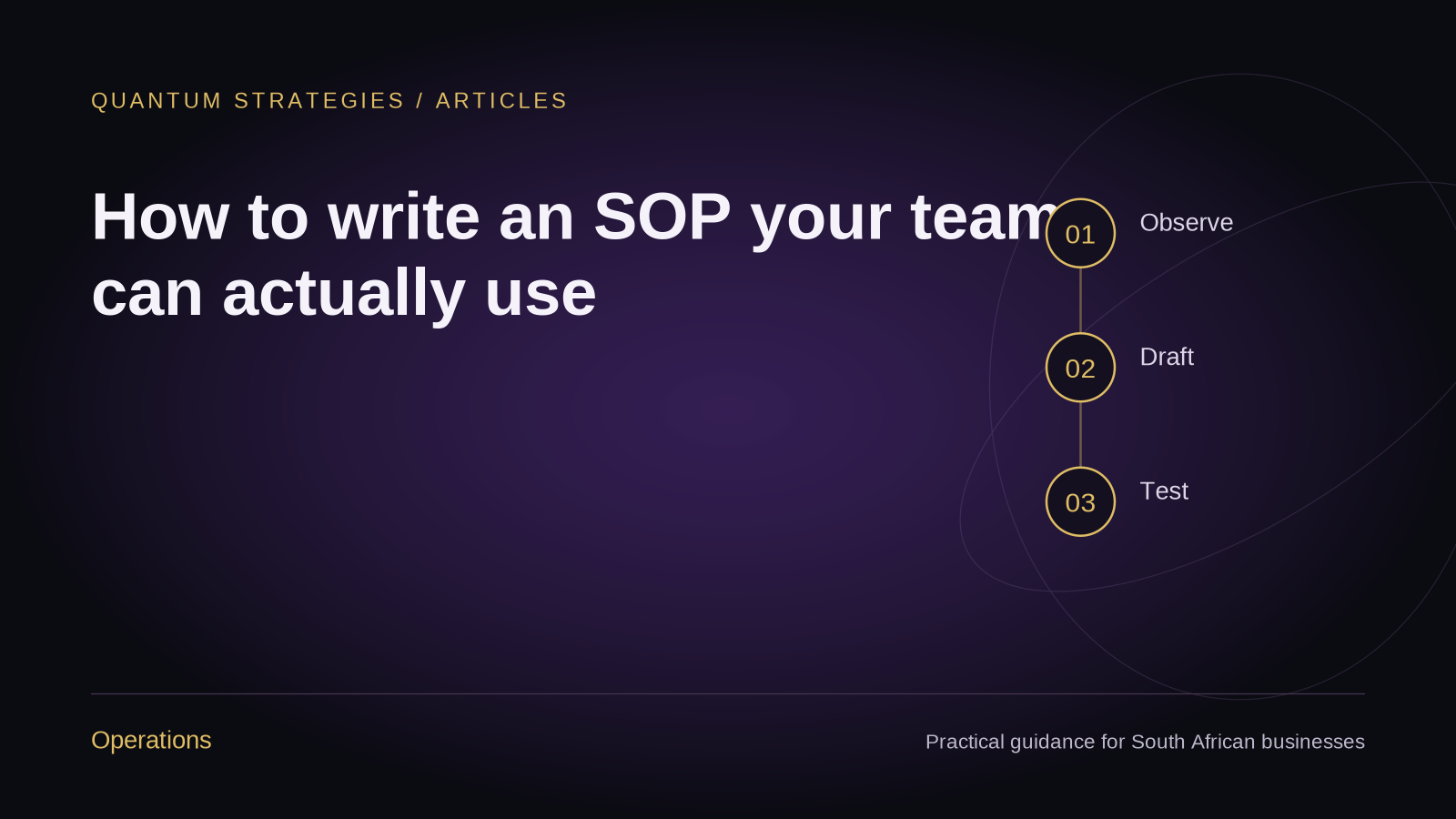
Observe
Actual work and exceptions
Draft
Actions and checks
Test
Normal and unusual cases
Maintain
Owner and current version
A general documentation workflow; specialist procedures need competent review.
Choose a process with a clear beginning and end
Define the trigger that starts the procedure and the result that completes it. “Manage customers” is too broad. “Receive an accepted quotation and hand the confirmed order to operations” is a manageable scope. Name the person responsible for the process and the people who use it.
Record the situations the procedure covers and the exceptions it does not. A routine order process may not suit urgent, unusual or high-value work. Specify when staff should stop and ask for a decision. For safety-critical, regulated or technically specialised work, the appropriate competent person must define and approve the controls; a general office SOP is not a substitute.
Observe the work before writing the ideal version
Walk through the current process with the people doing it. Look at a recent example, including messages, forms, approvals and rework. Ask where information is missing, where work waits and where different staff use different methods. Capture the actual sequence before deciding what should change.
ASQ’s flowchart guidance recommends mapping the current process and reviewing it with the people involved. A simple diagram can reveal a decision or handover that a paragraph hides. Keep the map readable; the goal is shared understanding, not elaborate symbols.
Write actions, decisions and checks
Use direct instructions with one main action per step. Name the record, system or template needed, and explain what a successful result looks like. “Check the order” is vague. “Confirm the customer name, approved scope, delivery date and purchase-order reference against the accepted quotation” gives the person something observable to do.
Separate an action from a decision. If information is incomplete, state who requests the missing detail and whether work may proceed. Include the check that prevents an error passing to the next person. Avoid copying passwords, personal records or other sensitive information into a broadly shared procedure.
- Purpose and scope: what the procedure achieves and when it applies.
- Owner and users: who maintains it and who performs the work.
- Inputs: information, authorisation and resources required before starting.
- Steps and decisions: actions in order, including exceptions and escalation.
- Completion evidence: what record shows that the work is ready for handover.
- Control details: version, approval date, location and next review trigger.
Illustrative example: handing an order to operations
Consider a small service business where sales sends accepted quotations to operations through informal messages. Jobs sometimes arrive without an agreed date or complete scope. The following is an illustrative process, not a client case study or a complete procedure for every business.
The trigger is written customer acceptance. Sales checks the accepted scope and required billing details, records the agreed requirements in the order record and flags any unresolved issue. Operations checks capacity before confirming a delivery commitment. The order is ready only when the responsible person accepts the handover and the customer receives the agreed confirmation.
The important control is not merely that a message was sent. It is that the receiving person has sufficient information and has acknowledged responsibility. The SOP should state what happens if capacity is unavailable or the customer changes scope after acceptance.
| Stage | Responsible role | Evidence |
|---|---|---|
| Validate acceptance | Sales | Accepted scope and required details recorded |
| Check capacity | Operations | Delivery commitment reviewed |
| Resolve exceptions | Named decision-maker | Decision and revised terms recorded |
| Complete handover | Sales and operations | Acknowledged order record and customer confirmation |
Test the procedure with someone using it
Ask a person familiar enough with the work to attempt a realistic case using the draft. Observe where they hesitate, infer an unwritten rule or need to ask the author. Revise those points. Test at least one exception as well as the normal path.
Training should explain the reason for important checks, not just instruct staff to tick boxes. If a step is impractical during busy periods, understand why. The solution might be a simpler form, clearer authority or a different handover. Adding more text does not fix a process that lacks the time or tools to operate.
Maintain one current version
Choose a location staff can access when they need the procedure. Mark the owner, version and approval date. Archive superseded versions so people do not follow an old attachment. Link to shared forms where practical, while checking that permissions and fallback access work.
Review after a meaningful process change, repeated error, system update or staff feedback. Keep a short change history explaining what changed and why. An SOP should support consistent work while remaining open to improvement; it should not freeze an ineffective process indefinitely.
Operations consulting can help examine workflows and document practical procedures. Training and development can support adoption. The Practical AI for Everyday Business course overview is relevant when considering AI-assisted drafting, but people who understand the work must verify every instruction and avoid exposing confidential information.
Common questions
How long should an SOP be?
As long as the task requires, but no longer than users can navigate easily. A short checklist may suit a routine handover; a complex process may need linked instructions and specialist controls.
Can AI write the SOP for me?
It can help organise approved information or suggest a draft structure. It cannot observe your actual workflow or reliably establish safety, legal or technical requirements. Verify the content with the responsible people before use.
What is the difference between a policy and an SOP?
A policy states a principle or rule, such as who may authorise spending. An SOP explains the steps for carrying out the related work, including the required approvals and records.
Sources and further reading
Official and specialist sources checked on 28 October 2026. Examples and diagrams in this article are illustrative.
- ASQ: Flowcharts and process mapsMap current work and review with the people involved; process maps reveal handovers, decisions, delays and improvement opportunities.