What to take away
- Discuss observable work and agreed expectations.
- Check systems and support before assuming a skills problem.
- Follow up on actions owned by both employee and manager.
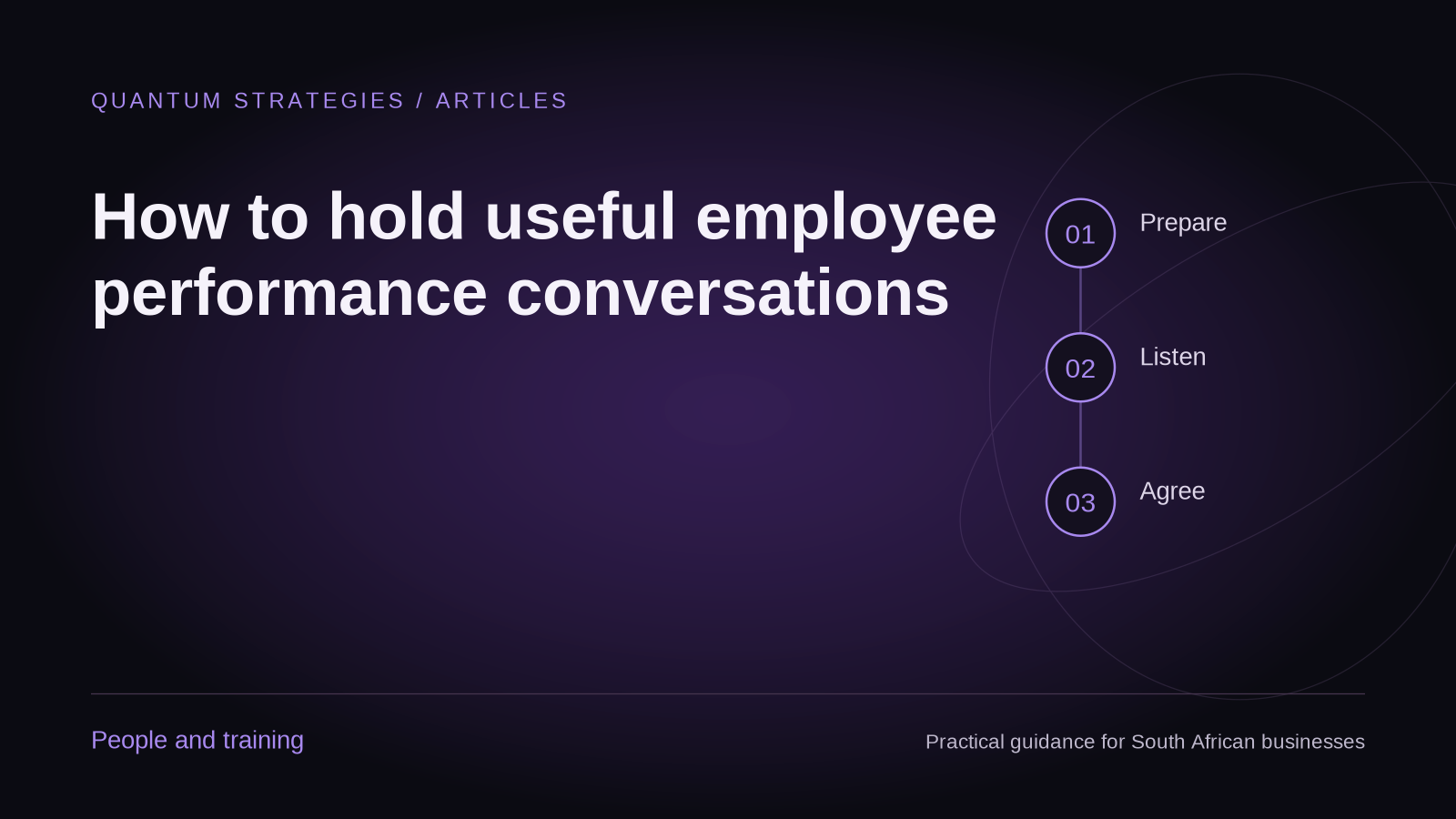
Prepare
Standard and work examples
Listen
Employee explanation
Agree
Action, support and owner
Review
Evidence of what changed
Illustrative management conversation, not a disciplinary or dismissal procedure.
Choose a specific purpose for the discussion
Decide whether you are reviewing progress, recognising good work, resolving a recurring difficulty or preparing for a new responsibility. Tell the employee the purpose beforehand and give them a reasonable opportunity to prepare. A routine development conversation should not unexpectedly become a decision about sanctions.
CIPD’s current performance-review guidance places structured reviews within a wider performance-management cycle. For a small team, a short discussion connected to actual work can be useful between more formal reviews. Choose a frequency that lets you address problems while the evidence is still clear, rather than copying another company’s calendar.
Prepare observations that can be checked
Bring the agreed standard and a small number of relevant examples. Describe actions, dates and consequences without making claims about the person’s character. “Three quotations lacked the required delivery assumption” gives you something to investigate. “You do not care about customers” assumes a motive and makes the discussion harder.
Check your own contribution before meeting. Was the standard communicated? Did the employee have reliable information, working tools, enough time and appropriate authority? Avoid using a sales total, customer complaint or deadline in isolation when other people or market conditions materially affected the outcome.
- Write down what you directly observed and what is still unverified.
- Include work that met the standard, not only the most recent error.
- Identify any change in workload, process or priority during the period.
- Prepare questions that invite the employee’s explanation.
Let the employee explain the work
Open with the purpose and the relevant example. Ask the employee to describe what happened from their perspective. Listen before deciding whether the issue is knowledge, practice, unclear responsibility, unavailable information or something requiring a separate HR conversation.
Useful questions include: “Which part of this task was difficult?”, “What information did you have at the time?” and “What would make the standard clearer?” Do not promise confidentiality you cannot maintain. If a sensitive matter arises, agree how it will be handled and involve only the people who need to act.
Turn a general criticism into an actionable agreement
A good next step specifies the work, the expected standard, the support and the review point. It should be within the person’s authority and realistically achievable with the resources available. Avoid a long list of improvements that compete for the same time.
| Vague instruction | More useful agreement |
|---|---|
| Be more proactive | Flag missing quotation information before the agreed handover time |
| Improve communication | Send the agreed status update with blockers and next actions |
| Make fewer mistakes | Use the checked order template and review a sample with the supervisor |
Worked example: repeated quotation corrections
In a fictional small supplier, a manager notices repeated corrections to delivery dates. During the conversation, the employee explains that the stock sheet is updated after quotations have already been prepared. The evidence suggests an information-timing problem alongside a need for a clearer checking habit.
They agree that the stock owner will publish a confirmed update each morning. The employee will mark unconfirmed delivery dates for review before sending a quotation. The manager will review a sample together at the next meeting. This example illustrates a plan, not a measured improvement or a substitute for assessing a real employee.
Record the agreement without turning it into a transcript
Keep a concise record of the examples discussed, the employee’s explanation, the agreed actions, each owner and the review date. Let the employee identify factual errors or record a different perspective. Separate an agreed fact from a manager’s interpretation.
Store notes in the approved private employment record, not a shared team chat. Do not include unnecessary health or family detail. When the matter may affect employment rights or require a formal process, ask an HR or legal adviser to review the approach before you proceed. An everyday meeting template cannot establish that a formal process is fair or complete.
Follow up on support as well as employee actions
At the next conversation, check whether the promised tools, training or manager decisions were actually provided. Review the work using the same standard. If the action did not help, investigate why rather than automatically increasing the target.
Quantum Strategies can scope HR support for performance-management processes and training needs. Business coaching may also help an owner develop clearer management habits. A useful starting pack includes the role expectations, existing review form and anonymised examples of the problem.
Common questions
Should every conversation use a numerical rating?
No. A rating is useful only when its meaning and evidence are clear. For many practical tasks, a reviewed work example and an agreed next action are easier to interpret.
What if the employee disagrees with the assessment?
Ask for their evidence, record the disagreement accurately and check the facts. Do not force agreement or bypass an applicable internal or legal process. Seek appropriate advice if the matter becomes formal.
Sources and further reading
Official and specialist sources checked on 28 October 2026. Examples and diagrams in this article are illustrative.
- CIPD: Performance reviewsStructured reviews as part of a wider performance cycle; reviewed January 2026. Conversation examples and workflow are original guidance.