What to take away
- Review the complete document against the intended deal.
- Make scope, costs, risk and exit questions explicit.
- Obtain case-specific legal advice before relying on a clause.
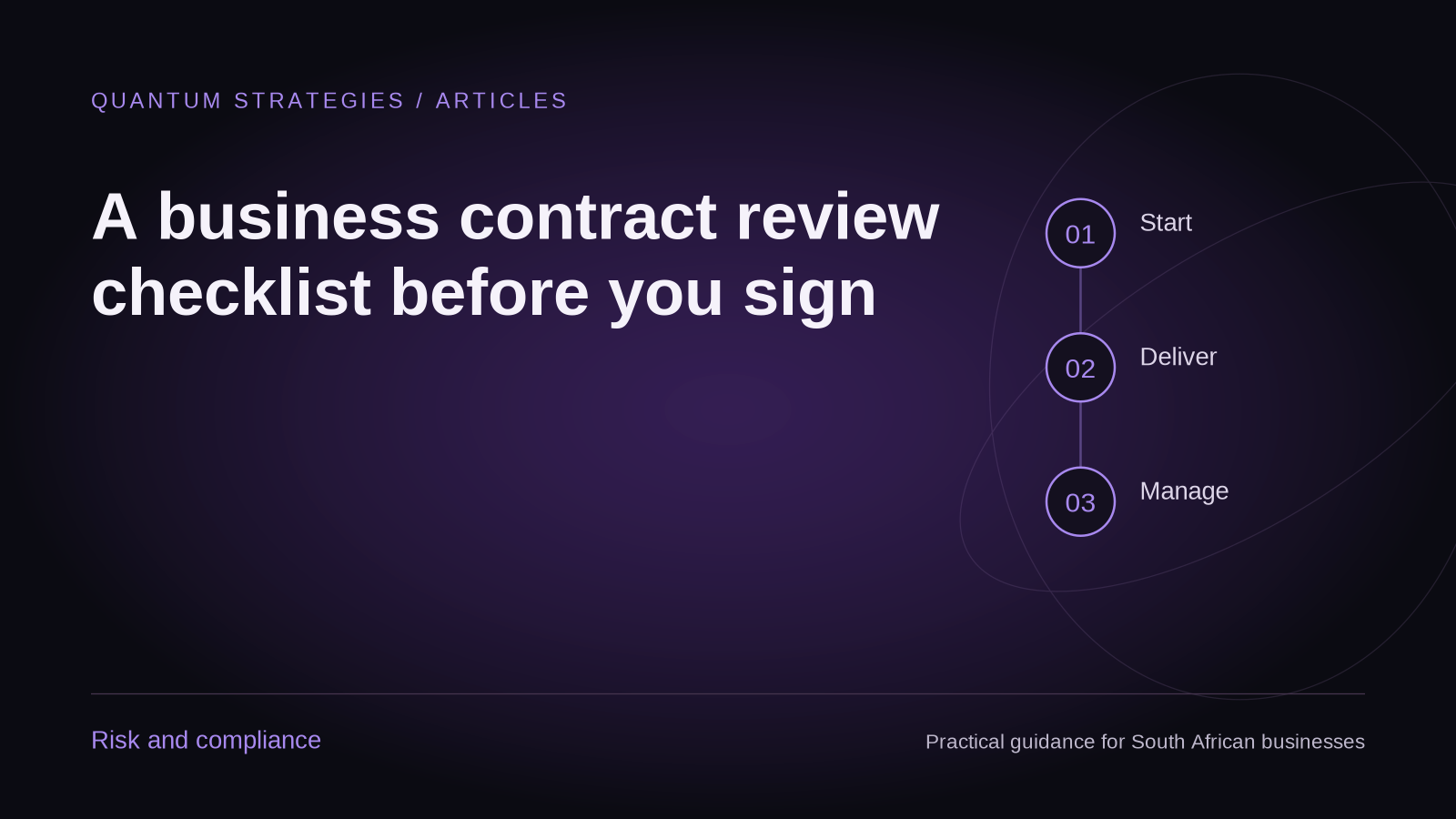
Start
Parties and complete scope
Deliver
Responsibilities and payment
Manage
Risk and changes
Exit
Renewal and handover
Original contract-preparation checklist; it does not replace a professional legal review.
Collect the complete agreement and describe the deal
Gather the main agreement, quotation, schedules, service description and any terms incorporated by reference. Check that every attachment is present and that you are reviewing the same version as the other party. A short signature page can still incorporate a long set of online terms.
Write a plain-language summary of the intended arrangement before reading the clauses. Identify the contracting entities, the authorised signatories, the purpose, the delivery period and the expected price basis. If the written agreement does not match that summary, list the difference for review rather than assuming an earlier conversation will resolve it.
Check scope and acceptance in practical terms
Ask whether the agreement describes the actual work clearly enough for the delivery team to follow. Distinguish included deliverables from optional work, assumptions and customer responsibilities. Where acceptance matters, understand who checks the work and what evidence establishes completion.
Consider a fictional website project. “Build a website” leaves questions about page count, content, hosting, revisions and ongoing maintenance. A clearer commercial brief identifies those items and the process for changing them. The appropriate legal wording still needs review for the particular agreement.
- What exactly must each party provide?
- Which dependencies could delay delivery?
- How are changes requested, priced and approved?
- Who accepts the work, against which agreed criteria?
- What support continues after the main deliverable is complete?
Understand the payment and cost commitments
Check the price basis, payment milestones, invoicing requirements, taxes where applicable, reimbursable costs and any escalation mechanism. Ask the reviewer to explain consequences of late payment, disputed invoices or early termination. Make sure the person responsible for accounts can implement the arrangement.
Calculate illustrative cash-flow effects using your own figures. A large upfront payment and a payment after acceptance create different funding needs even where the headline price is identical. Do not treat a lower quoted price as a complete comparison when travel, support or compulsory add-ons differ.
Identify clauses that need deliberate risk decisions
Flag provisions about liability, indemnities, insurance, confidentiality, intellectual property, personal information, guarantees and restrictions on future activity. Do not assume that a common clause is appropriate for your situation. Ask what exposure it creates and whether the business can meet the obligation.
South Africa’s Consumer Protection Act includes requirements concerning plain language and unfair terms where the Act applies. Its application and exclusions must be assessed for the particular transaction; it is not a universal answer for every business-to-business contract. A professional review should consider the relevant legal framework alongside the commercial facts.
| Topic | Question to take to the reviewer |
|---|---|
| Liability and indemnities | What losses or claims could we become responsible for? |
| Intellectual property | Who can use, modify or retain the work? |
| Confidentiality and data | What must be protected, by whom and for how long? |
| Guarantees or security | Does anyone assume obligations beyond the operating business? |
| Disputes | What procedure, location and costs could apply? |
Read the renewal and exit arrangements now
Find the duration, renewal mechanism, notice method and termination provisions. Put relevant review dates into the business calendar. An agreement that is manageable at the start may become inconvenient if you overlook a renewal step.
Ask what happens to unfinished work, prepaid amounts, equipment, accounts, data and access when the relationship ends. For a software supplier, a practical question is whether you can obtain a usable export and who will assist with transition. Have the legal adviser assess the contractual rights rather than relying on a salesperson’s informal assurance.
Create a short issue list for professional review
For each concern, record the clause reference, the business consequence and your preferred outcome. Prioritise issues that affect delivery, payment or material exposure. A focused brief makes it easier for the reviewer to understand the commercial decision you face.
For example, write: “Schedule B promises next-day support, but clause 8 describes a different response period. We need one clear commitment.” That is more useful than asking whether the contract is “standard”. Keep proposed revisions and responses in a controlled version so that important changes do not disappear between drafts.
Confirm the final version and manage the agreement
Before signature, check that agreed amendments appear in the final document, all schedules are attached and the authorised people are signing the correct entity’s agreement. Store the executed version where the people managing delivery can access it appropriately.
Quantum Strategies offers business legal consulting, including contract drafting and review, with court representation outside its stated scope. An enquiry should identify the agreement type, deadline and purpose without sending unnecessary confidential material through a public form. Agree a suitable document-sharing route and the review scope first.
Common questions
Can I use a template found online?
A template may help identify topics, but its terms and legal assumptions may not fit your deal or jurisdiction. Have the relevant agreement reviewed rather than treating the template as approval.
Is a contract review only needed for large deals?
Value is one consideration. Ongoing obligations, personal guarantees, data access, operational dependence and difficult exit terms can matter even where the initial price is modest.
Sources and further reading
Official and specialist sources checked on 28 October 2026. Examples and diagrams in this article are illustrative.
- Consumer Protection Act 68 of 2008Sections 5, 22 and 48 concern application, plain language and unfair terms. No determination of applicability or enforceability for a particular contract is made.