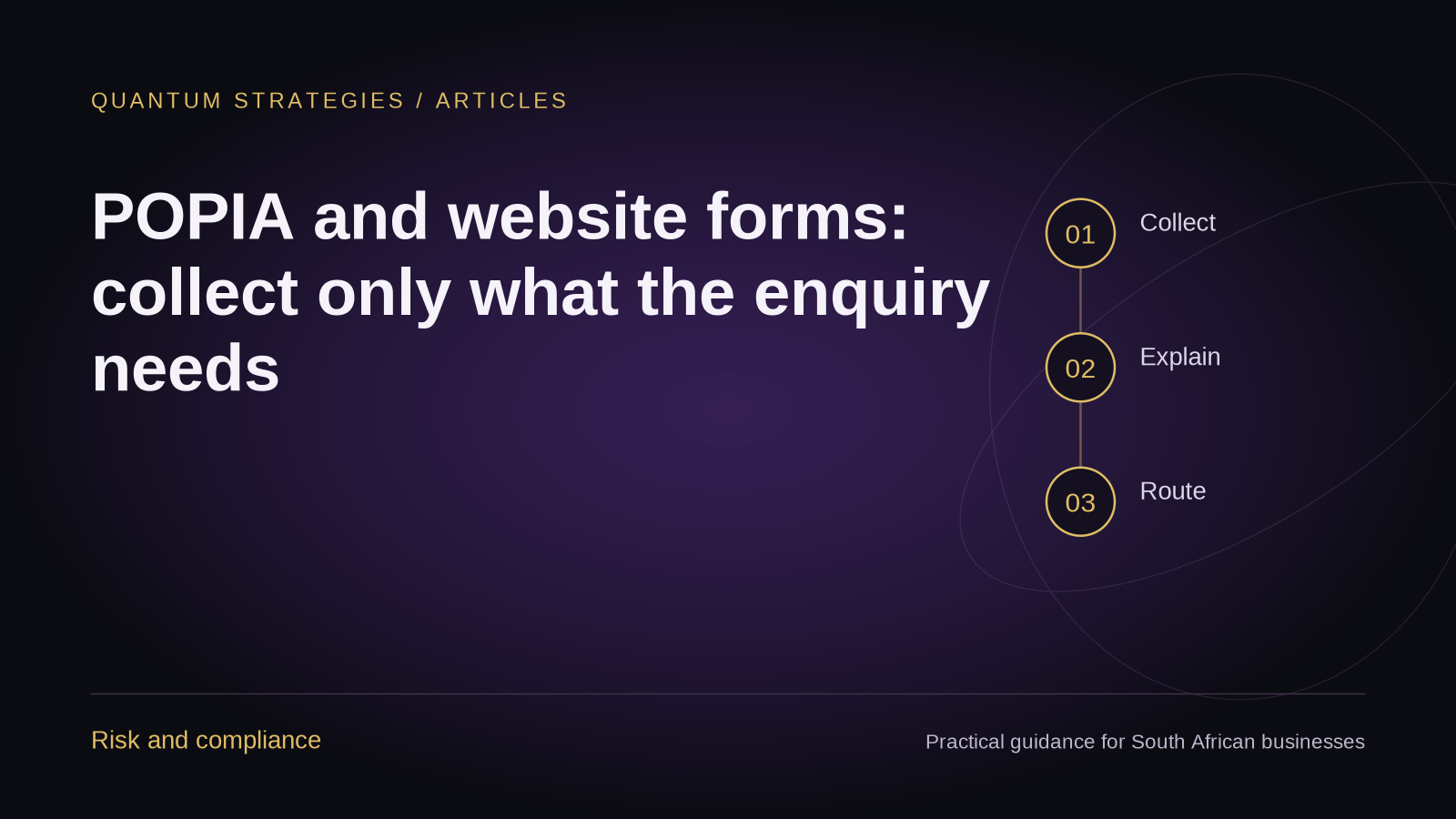
What to take away
- Give every field a specific purpose.
- Review storage, routing and retention beyond the webpage.
- Measure the action without sending personal details to analytics.
Collect
Only necessary details
Explain
Purpose and contact route
Route
Protected operational systems
Review
Access, retention and analytics
Illustrative data-flow review; each receiving system needs an identified purpose and appropriate controls.
Write down the purpose of the form
Use a specific purpose such as “receive a service enquiry and contact the person about it”. Then ask what information is needed for that purpose. A general first enquiry may need a contact route, an optional name and a short description of the business need. It may not need an identity number, home address or uploaded financial records.
POPIA section 10 requires information to be adequate, relevant and not excessive for its purpose. Sections 11, 13, 14, 18 and 19 address lawful processing, purpose, retention, collection notices and security. These requirements need to be considered together; adding a checkbox does not resolve all of them.
Challenge every required field
Make a field inventory with its purpose, whether it is required, who uses it and how long it needs to be retained. If nobody can explain why a field is needed at the first contact stage, remove it or collect it later through an appropriate process.
An optional field can still create unnecessary risk. A large free-text box invites people to include more detail than you need. Provide a short instruction asking for the type of assistance required and discouraging sensitive documents or personal identifiers at this stage.
| Proposed field | First-enquiry question |
|---|---|
| Email address | Is this the contact route needed to answer? |
| Phone number | Is it optional, or genuinely required for this service? |
| Company name | Will it help route the enquiry, and can it be optional? |
| Identity number | Why would this be necessary before scope is agreed? |
| Attachments | Can secure document exchange happen after initial contact? |
Explain collection where the person needs the explanation
Place a short, understandable notice beside the form and link to fuller privacy information. It should accurately explain the purpose and identify the responsible business and appropriate contact route. Have the required section 18 information and any applicable exceptions assessed for your circumstances.
Separate an enquiry from a marketing subscription. A person asking for a quotation should not have to guess whether they are joining a mailing list. Electronic direct marketing has its own requirements under POPIA, including section 69; obtain appropriate advice before designing that separate process. Do not assume consent is the only possible lawful basis for every use of personal information.
Map what happens after the person presses Submit
List every place the enquiry travels: browser, web server, form processor, email service, mailbox, CRM, logs and backups. Identify who can access each location. Include contractors and hosting providers in the review rather than treating the form itself as the entire system.
Use HTTPS, server-side validation and appropriately restricted storage. Keep submitted data out of public folders and error messages. Check that spam controls do not silently discard genuine enquiries. Agree retention and deletion arrangements that fit the purpose and applicable obligations, including how copies in connected systems are handled.
Keep personal information out of analytics
Google’s Analytics guidance prohibits sending personally identifiable information to Analytics and highlights URLs and other collected fields as risk areas. A form should not redirect to a URL containing an email address, phone number or the person’s message. Analytics event labels should describe the action, not identify the enquirer.
For a successful service enquiry, a safe reporting design might send an event name and an approved service category. The message, contact details and private reference lookup remain in the business’s protected operational records. Review automatically collected page URLs, titles and referrers too; a clean custom event does not fix a leaking URL.
Worked example: simplify a consulting enquiry form
A fictional consultancy’s form requires a name, surname, identity number, street address, company revenue, phone number, email and an attachment. Its immediate purpose is only to arrange an initial discussion. The review proposes a contact name, one suitable contact route, service category and short message, with other information requested later if necessary.
The team also changes the success page to a neutral receipt and checks that email details never enter analytics. These are illustrative design decisions, not a universal field list or a legal compliance finding. The appropriate design depends on the service and the business’s actual processing arrangements.
Test the whole journey with fictional information
Submit a valid test enquiry and verify that the designated recipient can find it. Test missing fields, an invalid address and a server failure. Confirm that the visitor sees an accurate outcome and that technical errors do not expose submitted information. Inspect network requests and relevant logs using only authorised test access.
Quantum Strategies can scope legal and IT support for the policy and technical parts of this work. The review should distinguish the lawful processing decisions from the implementation checks and clearly record what remains unverified.
Common questions
Does a privacy policy make a form POPIA compliant?
No. The policy must match actual processing, and the wider requirements still need to be met. Review purpose, legal basis, notices, security, access, retention and connected providers together.
Can we collect information now in case we need it later?
Avoid speculative collection. Define the current purpose and collect information that is appropriate to it. If a later stage genuinely needs more detail, design that collection and notice deliberately.
Sources and further reading
Official and specialist sources checked on 28 October 2026. Examples and diagrams in this article are illustrative.
- Protection of Personal Information Act 4 of 2013Sections 10–14, 18–19 and 69 support minimality, lawful processing, purpose, retention, notice, safeguards and electronic direct marketing distinctions.
- Google Analytics: Avoid sending personally identifiable informationAnalytics restriction on PII and checking URLs, titles and collected fields. Technical examples are original recommendations.