What to take away
- Prioritise critical work and its dependencies.
- Define fallbacks, limits and decision authority.
- Test recovery and reconciliation, not just access.
- Update arrangements when the business changes.
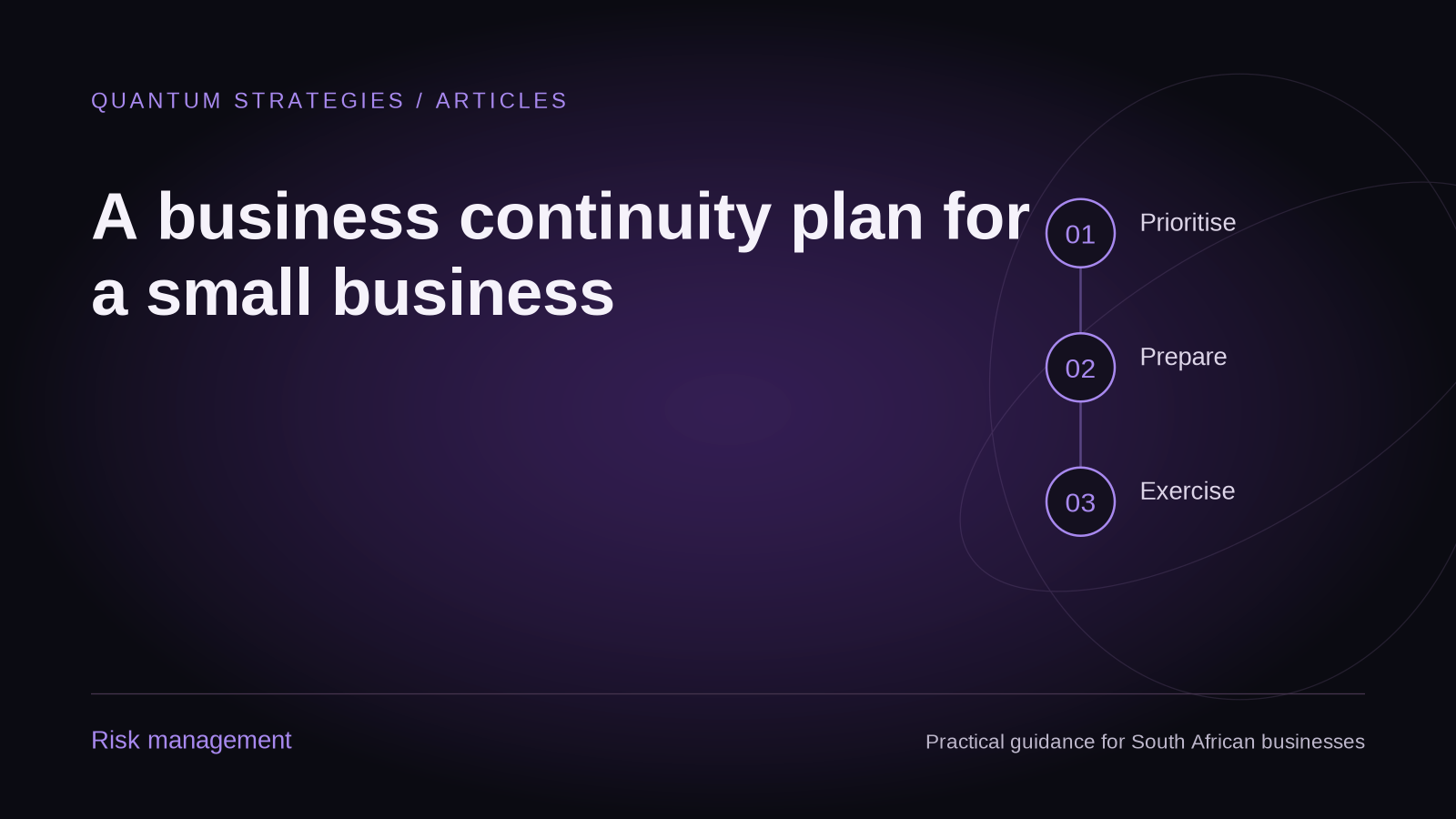
Prioritise
Critical work and impact
Prepare
Fallbacks and authority
Exercise
Access and recovery
Improve
Gaps and changed conditions
General continuity planning sequence; immediate safety arrangements take priority.
Distinguish immediate response from continuity
If an incident threatens people, immediate safety and emergency arrangements take priority. Business continuity then concerns maintaining or restoring important activities within acceptable limits. It is connected to emergency response, IT recovery and risk management, but none of those alone covers the whole operating picture.
ISO 22301’s public overview describes a documented management system for preparing for and recovering from disruption. This guide offers a practical starting structure for a small business; it does not claim compliance with the full standard or replace specialist emergency and safety procedures.
Identify critical activities and their dependencies
List the services and tasks whose interruption would create serious consequences. Ask how the effect changes over time: a delayed internal report may be tolerable, while an inability to dispatch an essential customer order may become serious much sooner. Define the minimum service the business needs to maintain.
For each critical activity, identify people, premises, equipment, information, systems, suppliers and approvals. A backup application does not help if nobody can access it or if the necessary records are unavailable. Include less obvious dependencies such as a single administrator, an authentication device or a specialised component.
- Activity: what must continue or be restored?
- Impact: what happens if it stops, and how does that worsen over time?
- Minimum output: what reduced service would be acceptable temporarily?
- Dependencies: which people, information and resources are essential?
- Recovery requirement: when must the activity resume and what data loss is tolerable?
- Owner: who decides, coordinates and confirms recovery?
Choose fallbacks that fit the actual work
Possible arrangements include trained backup staff, alternative suppliers, an approved manual process or access to another suitable workspace. The right choice depends on the activity and its controls. A manual workaround must still protect information, preserve necessary records and prevent unauthorised decisions.
Document how the fallback is activated, what it can and cannot handle, and how long it can operate. Verify availability instead of assuming another supplier or venue will help during a widespread disruption. Where contracts or specialist requirements apply, obtain the appropriate advice and agreement before relying on the arrangement.
Illustrative example: an order system becomes unavailable
Imagine a small wholesaler cannot access its normal order system. The owner decides that existing confirmed orders are the immediate priority. A controlled offline list, prepared through an approved process, contains the minimum information needed to identify those orders. This is an illustrative scenario, not a recommendation to export unrestricted customer data.
The fallback assigns one coordinator to record order status, one person to communicate with customers and a designated person to approve exceptions. Staff avoid accepting commitments they cannot verify. New orders are recorded through a controlled method with unique references so they can be reconciled later.
When the system returns, the team checks what was dispatched, changed or cancelled before entering updates. Recovery is not complete merely because a login works. The business must confirm that records are accurate and that duplicate orders or missed commitments have been resolved.
Prepare communications and decision authority
Keep an accessible contact list for the people needed during a disruption, with appropriate privacy and access controls. Identify who may activate the plan, authorise exceptional spending and communicate externally. Name deputies in case the usual decision-maker is unavailable.
Prepare short message structures for staff, customers and suppliers. State what is known, what service is affected, what action is required and when the next update will come. Avoid promising a recovery time before it has been established. Use an alternative communication route if the normal channel is part of the disruption.
Test the plan before relying on it
Begin with a discussion exercise using a realistic scenario. Ask participants to work through the first decisions and locate the information they need. Note missing contact details, unclear authority and assumptions that cannot be confirmed. Then test selected technical or operational recovery steps safely with the responsible specialists.
A backup record is not proof that restoration works. Check the ability to recover the required information within the relevant time and access controls. Likewise, a nominated deputy needs the training and authority to perform the role. Record test conditions and limitations so a successful small exercise is not presented as proof against every disruption.
- Choose a scenario and define the test boundary.
- Confirm who participates and what normal operations must remain protected.
- Observe decisions, access, communications and recovery steps.
- Record gaps, assign corrective actions and retest significant failures.
- Update the plan and brief the people who will use it.
Keep the plan usable as the business changes
Review the arrangements after significant staffing, supplier, premises or system changes, and after an incident or exercise. Keep one current version available through a route that still works if the normal system fails. Protect sensitive recovery details from unnecessary exposure.
Risk management consulting can help organise continuity responsibilities and review arrangements. IT consulting is relevant to systems and information dependencies, while operations consulting can help define workable service fallbacks. Start with the critical activity, the disruption you are concerned about and the arrangements already in place.
Common questions
Is a data backup enough for business continuity?
No. A backup addresses part of information recovery. Continuity also depends on people, access, equipment, suppliers, decisions and the ability to operate and reconcile work during disruption.
How often should a small business test its plan?
Set a cadence appropriate to the consequences and rate of change, and test after material changes. The scope may range from a discussion exercise to a controlled recovery test with specialists.
Must every activity recover immediately?
No. Prioritise activities according to impact and time sensitivity. Define acceptable temporary service levels so limited resources support the most important work first.
Sources and further reading
Official and specialist sources checked on 28 October 2026. Examples and diagrams in this article are illustrative.
- ISO 22301:2019 — Business continuity management systemsPublic overview: documented management system to prepare for, respond to and recover from disruption. No full-standard compliance claim.