What to take away
- Write cause, event and consequence clearly.
- Separate existing controls from planned actions.
- Use scores alongside evidence and judgement.
- Assign owners and review whether controls actually operate.
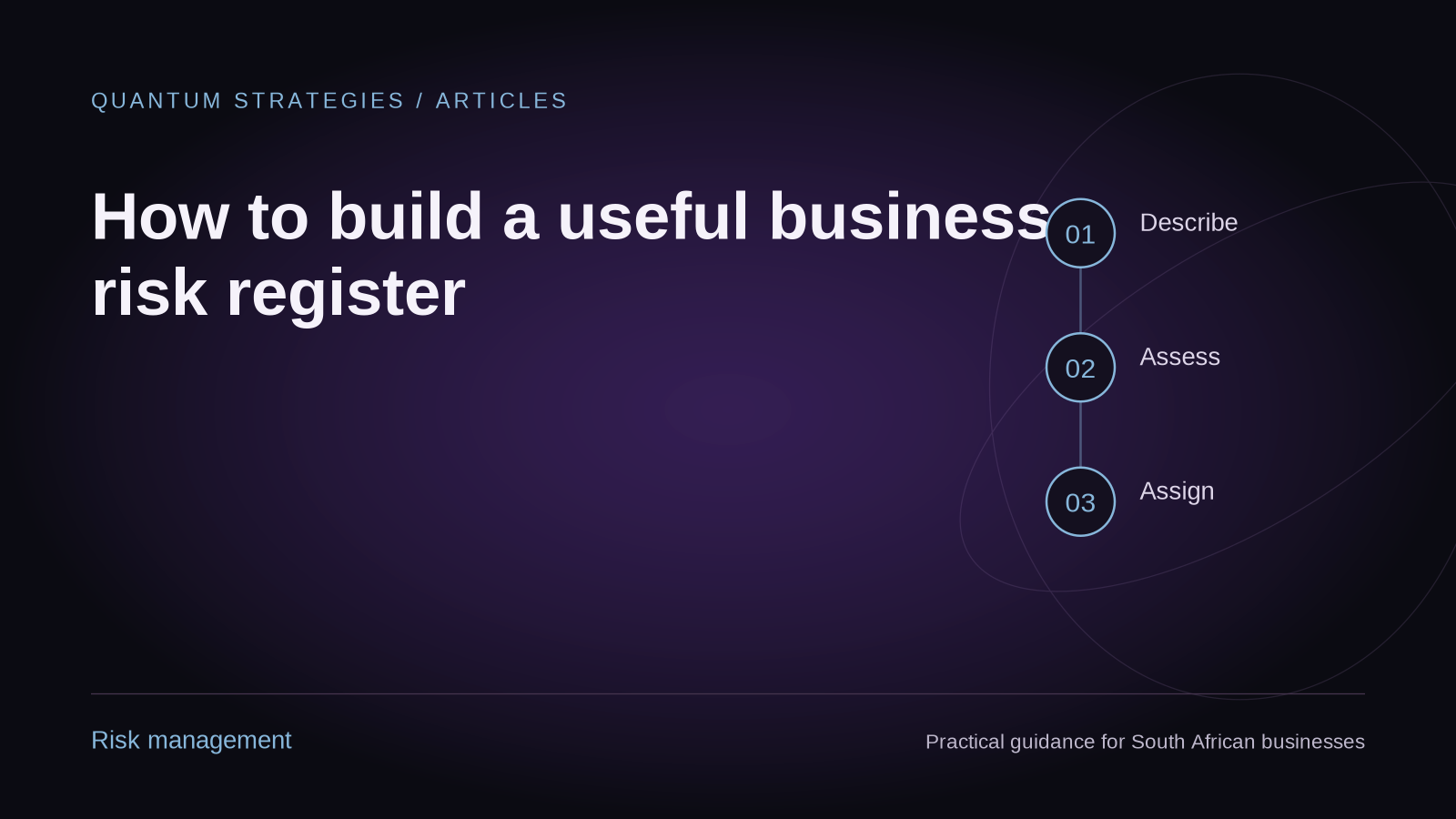
Describe
Cause, event and effect
Assess
Controls and exposure
Assign
Owner, action and date
Review
Evidence and changes
General management guidance; specialist assessments remain separate where required.
Define the objective and the risk clearly
Choose the activity or objective being considered: fulfilling customer orders, protecting information, maintaining cash availability or delivering a project. Describe a risk as a possible event, its cause and its consequence. “Suppliers” is a category, not a usable risk statement.
A clearer statement is: “If the sole approved supplier cannot deliver a critical component, scheduled jobs may be delayed because no alternative has been tested.” This wording identifies the uncertainty and why it matters. Avoid combining unrelated causes and consequences into one entry, because their controls and owners may differ.
Use a framework without claiming certification
ISO 31000’s public overview describes principles, a framework and a process for managing risk across organisations. It also states that ISO 31000 is guidance and is not a certifiable standard. A spreadsheet inspired by general risk-management principles does not establish compliance with a full standard.
The register in this guide is a general business tool. It does not replace specialist health and safety assessments, environmental work, legal analysis, cybersecurity testing or other required professional processes. Link those activities where relevant and clarify who is responsible for them.
Record controls as things that actually happen
An existing control should describe an operating measure, not an intention. “Maintain backups” is incomplete if nobody knows what is backed up or whether restoration works. “A designated person reviews the backup report and records a restore test at agreed intervals” is more inspectable, provided it genuinely occurs.
Separate current controls from proposed actions. Record evidence of effectiveness and any known weakness. A policy may be necessary, but its existence does not prove staff follow it. Ask what would show that the control operated when needed and where that evidence is kept.
- Objective and risk statement: what could happen and why it matters.
- Existing controls: measures currently in operation and their evidence.
- Assessment: agreed likelihood and consequence descriptions, with uncertainty.
- Owner: the person accountable for monitoring and decisions.
- Action: the next treatment, responsible person and due date.
- Review: trigger, status and the evidence required to close an action.
Illustrative example: dependence on one supplier
Imagine a workshop relying on one supplier for a critical component. The owner has a contact number and normally orders in advance, but no alternative component has been checked. This is an illustrative scenario, not a client risk assessment.
The risk owner might be the operations manager. A proposed action could be to investigate an alternative supplier and arrange a technical suitability review before any substitution. Another action could establish an agreed reorder trigger based on lead time and usage. Neither should be marked complete merely because someone sent an enquiry.
Closure evidence might include the suitability decision, approved purchasing details and a revised procedure. If no acceptable alternative exists, the owner must consider other responses and explicitly acknowledge the remaining exposure. The register should preserve that decision rather than hide it behind a lower score.
| Field | Illustrative entry |
|---|---|
| Risk | Critical component unavailable, delaying scheduled work |
| Current control | Advance ordering; supplier contact maintained |
| Gap | No tested alternative; reorder trigger unclear |
| Next action | Assess alternatives and define reorder responsibility |
| Evidence for review | Suitability decision and approved process recorded |
Use scores to support discussion, not replace it
Define the meaning of likelihood and consequence before rating risks. Use categories that staff can apply consistently, and record the basis for important assessments. A numerical score can help sort a list, but it is not a precise forecast of loss or probability unless a suitable quantitative method supports it.
Two risks with the same score may require different responses. A low-frequency event with severe consequences may deserve urgent specialist attention. A frequent minor error may need a process correction. Keep the underlying descriptions visible and avoid reducing the decision to a colour alone.
Assign actions and test whether controls work
Discuss whether to avoid an activity, reduce exposure, share some consequences through an appropriate arrangement or accept the remaining risk within the organisation’s authority. The choice depends on the objective, available resources and relevant obligations. Insurance, where appropriate, does not remove every operational consequence.
Give actions realistic dates and identify dependencies. Review overdue actions and changes in circumstances. Check a sample of control evidence rather than accepting “done” without support. When a control fails, investigate the reason and update the assessment; a register should reflect current conditions, not last year’s intentions.
Build the register into normal management
Include relevant risks in project and operating reviews. Add a review trigger after a material incident, supplier change, new system or expansion. Archive resolved entries with their decision history rather than silently deleting them. Keep sensitive details accessible only to the people who need them.
Risk management consulting can help organise risks, controls and responsibilities. Operations consulting can address recurring process weaknesses. For specialist matters, agree the appropriate professional input and scope. A useful initial enquiry describes the objective at risk, current arrangements and the decision you need to make.
Common questions
How many risks should a small business record?
Enough to cover the important uncertainties affecting its objectives without creating an unmanageable list. Start with material risks and expand when evidence shows a need.
Who should own a risk?
Someone with sufficient responsibility and authority to coordinate monitoring, decisions and action. The person completing a particular action may differ from the accountable risk owner.
Can a completed register make the business ISO 31000 certified?
No. ISO 31000 is a guidance standard and is not used for certification. A register is one management tool and does not by itself demonstrate an effective risk-management system.
Sources and further reading
Official and specialist sources checked on 28 October 2026. Examples and diagrams in this article are illustrative.
- ISO 31000:2018 — Risk management guidelinesPublic overview: principles, framework and process applicable across organisations; ISO 31000 is guidance and not certifiable.