What to take away
- Begin with a decision and an uncertainty.
- Ask about recent behaviour and actual alternatives.
- Keep samples, dates and limitations visible.
- Distinguish interest, enquiries, orders and paid sales.
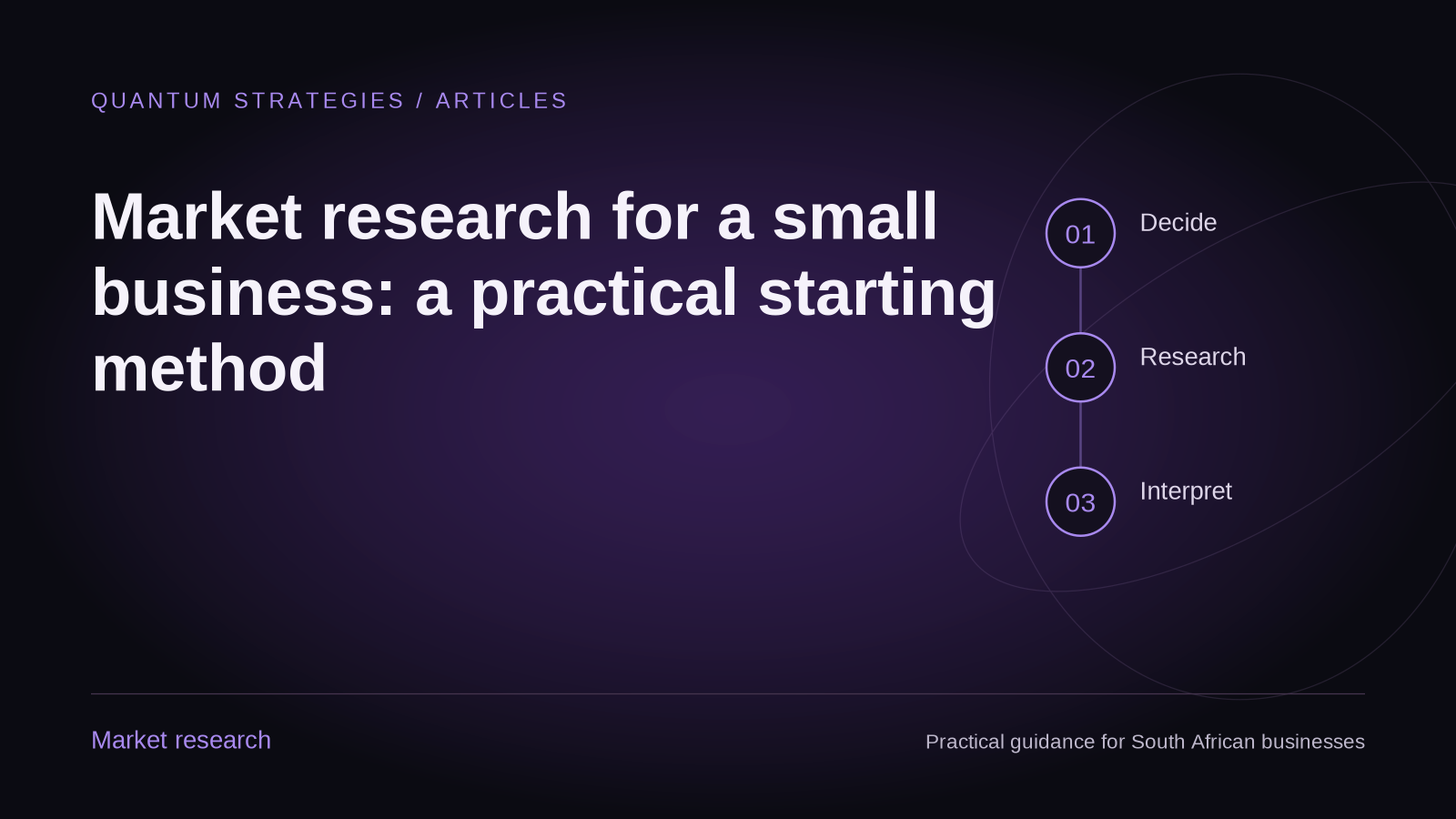
Decide
Name the uncertainty
Research
Customers and alternatives
Interpret
Evidence and limits
Test
Observe a real next step
Each stage answers a different question; interest is not a completed sale.
Turn the business question into a research brief
State the decision, the people affected and the uncertainty. For example: “Should we offer a monthly maintenance package to independent retailers in our delivery area?” is more researchable than “Is there a market for maintenance?” The first question defines an offer, customer group and operating boundary.
List what you already know and how you know it. Existing invoices, enquiry notes and lost quotations may provide a starting point. Record where information is missing or unreliable. Decide how the findings will be used and what evidence would make you change the offer, run a pilot or stop. This prevents research becoming a search for reassuring opinions.
Combine existing information with direct customer research
Secondary research uses information already collected, such as official statistics, public company information and industry publications. Primary research collects information for your own question, through methods such as interviews, observation or a carefully designed survey. Each has limits: a large national dataset may not describe your local buyers, while a few interviews cannot estimate an entire market.
Statistics South Africa’s place-based resources can help identify relevant official geographic information. Check the date, definition and boundaries of the dataset you select. Population counts, for example, are not counts of people willing and able to buy a particular service.
The SBA’s planning guidance distinguishes research into customers from analysis of competing offers. Use both perspectives, while treating its US-specific references as context rather than South African requirements.
Ask about real behaviour before hypothetical enthusiasm
Interview people who fit the intended customer group, including those who have chosen another provider or decided not to buy. Friends and enthusiastic followers are convenient to reach, but they may not reflect the people making the actual purchasing decision.
Ask about the last time the problem occurred. What happened, what did they do, who approved the purchase and what made it difficult? Follow up on specific details. “Would you buy this?” can produce polite encouragement with little practical meaning. Questions about recent behaviour reveal existing alternatives, constraints and decision processes.
- When did this problem last happen, and what was its consequence?
- How did you solve it, including internal work or postponement?
- Who decided, who paid and what information did they need?
- What did the current solution cost in money, time or inconvenience?
- What would have to change before you considered a different approach?
Compare alternatives from the customer’s perspective
Record the offers a buyer can actually choose: scope, delivery method, price where public, evidence, terms and next steps. Include indirect alternatives such as hiring internally, using software or doing nothing. A competitor list based only on businesses that resemble yours can miss the option customers most often choose.
Keep observations dated and distinguish a provider’s claim from independently verified evidence. Search results are a snapshot affected by query and context; they are not a stable league table. Likewise, search volume reflects searches under particular settings, not unique buyers, confirmed demand or likely sales. Use those signals to refine questions, not to manufacture a market-size claim.
Illustrative example: testing a maintenance package
Suppose a business interviews 12 independent retailers selected from different shop types within its delivery area. Eight describe recent equipment interruptions, five currently use an outside provider and three request a quotation for the proposed package. These figures are illustrative and are not research results.
The interviews suggest useful themes, but the business cannot conclude that two-thirds of all local retailers will buy. The sample is small and may not be representative. Three quotation requests are stronger evidence of a next step than general enthusiasm, yet they are still not paid subscriptions.
The owner could refine the package around the most frequent purchasing concerns, then offer a limited pilot with clear terms. Record how many suitable businesses were approached, how many enquired, how many accepted and why others declined. That creates evidence about an actual offer under stated conditions.
Write findings that support a decision
Summarise what you observed, what it might mean and how certain you are. Keep contradictory evidence visible. A customer may value faster response but reject the proposed monthly commitment; both findings matter. Quote or identify participants only with appropriate permission, and keep personal details out of public reports.
End with a decision and a next test. Explain the offer changes, remaining questions and limits of the work. Research is useful when it reduces a meaningful uncertainty, even if the answer is that more evidence is needed.
Market research services can help define the question and evidence plan. Marketing consulting can turn findings into a clearer offer and enquiry journey. For understanding measured website behaviour alongside customer research, explore the public overview of Understanding Google Analytics 4.
Common questions
How many customer interviews do I need?
There is no universal number. It depends on the decision, diversity of customers and method. Small exploratory interviews can reveal themes, but estimating population percentages requires an appropriate sampling and analysis design.
Can Google searches prove demand?
No. Search behaviour can reveal language and information needs, but includes research, recruitment and other intentions. Validate the actual offer through customer evidence and observable buying steps.
What if customers give conflicting answers?
Look for differences between customer groups, situations and buying roles. Do not average away a meaningful distinction; it may suggest separate offers or a narrower target audience.
Sources and further reading
Official and specialist sources checked on 28 October 2026. Examples and diagrams in this article are illustrative.
- Statistics South Africa: Statistics by placeOfficial geographic statistical source; individual datasets must be checked for date, boundaries, definitions and relevance.
- US Small Business Administration: Plan your businessGeneral business-plan structure and distinction between market research and competitive analysis; US funding/legal requirements are not applied to South Africa.