What to take away
- Measure the whole flow and distinguish effort from waiting.
- Use queues as clues, then test the underlying cause.
- Improve the limiting step without dropping controls.
- Monitor quality and any new constraint after the change.
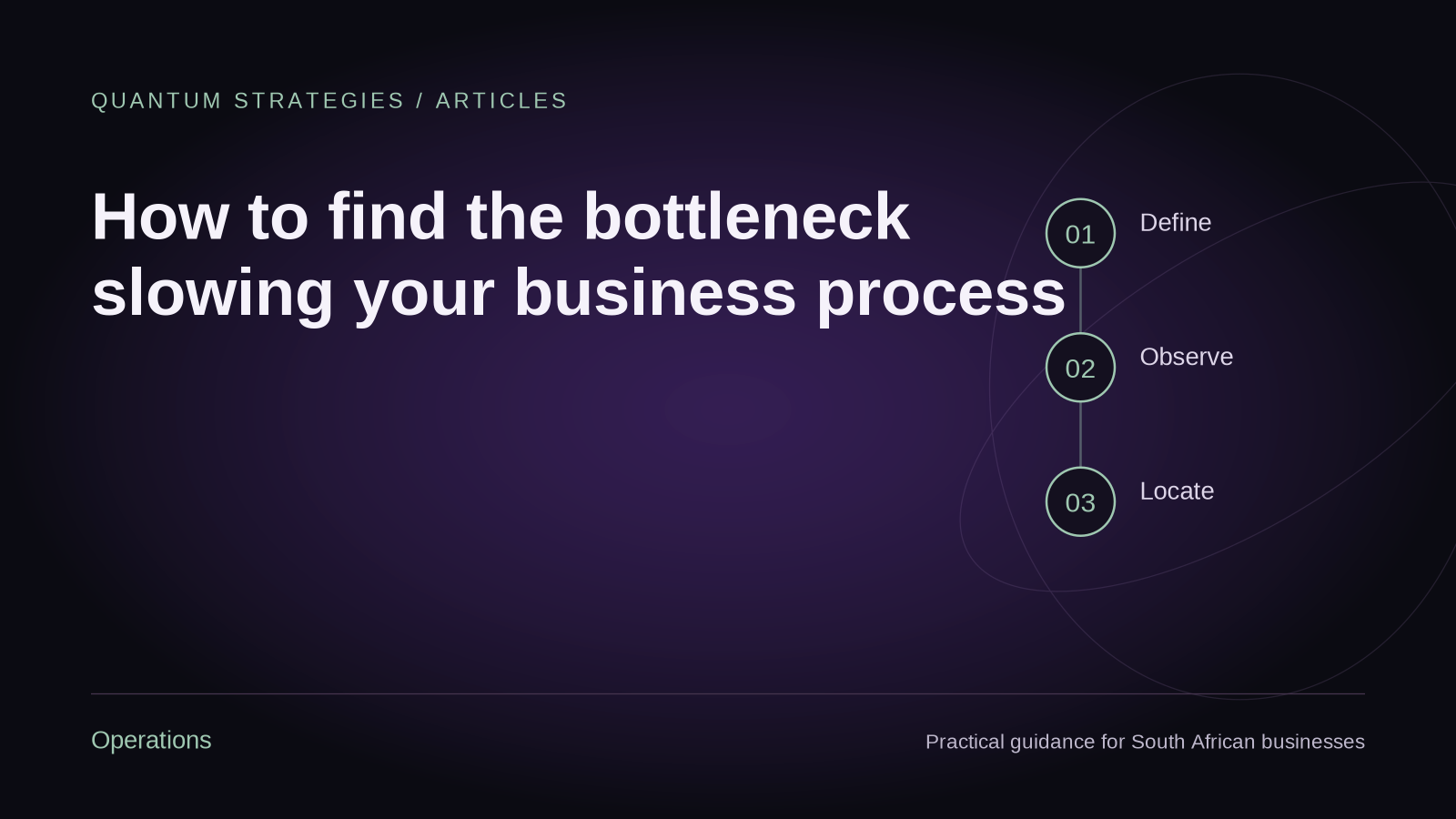
Define
Outcome and boundaries
Observe
Work, waiting and rework
Locate
The limiting constraint
Test
Output and quality together
Illustrative method; a queue is a clue rather than proof on its own.
Define the outcome and the process boundary
Choose one flow of work, such as quotation requests becoming issued quotations or accepted orders becoming completed jobs. Define when timing starts and ends. If one team measures from assignment and another from the customer’s original request, their turnaround figures are not directly comparable.
Specify the outcome you want to improve: completed jobs, elapsed time, reliability or another meaningful measure. Include a quality condition so faster completion does not simply mean more errors. Avoid starting with a department-wide productivity target before understanding the flow across departments.
Map the route and record waiting
Trace a sample of recent cases through each step. Record arrival time, work start, completion, handover and any return for correction. Separate active work from waiting. A task that takes 15 minutes of effort can still take three days to complete if it waits for approval.
Ask staff what prevents work progressing. Group causes such as incomplete information, unavailable approval, limited equipment or repeated rework. Observe different types of jobs and busy periods rather than drawing conclusions from one easy case. Keep customer and employee details private in shared analysis.
Identify the limiting step
A recurring queue before a step can be a clue, but it is not sufficient on its own. The queue may reflect batching, priorities or an upstream surge. Compare incoming workload, effective capacity and actual completed output. Check whether later steps are waiting for this work or have a different constraint.
The public ASQ overview of the theory of constraints describes focusing improvement on the process’s limiting constraint. Apply the idea with evidence: making an already fast step faster may add to the queue without increasing completed output.
Illustrative example: a quotation process
Imagine a team receiving 12 complete quotation requests each working day. Preparation can handle 15, approval can handle eight and sending can handle 20. Assume requests are similar and no other constraint applies. These simplified capacities are illustrative, not measured business results.
Under those assumptions, approval limits completed quotations to eight a day and the approval queue grows by about four requests a day. Increasing preparation capacity to 20 does not remove that limit. It may only deliver work to the same queue more quickly.
Before hiring another approver, investigate why capacity is eight. Perhaps routine quotations wait for the owner, incomplete pricing evidence causes rework, or approvals occur only in one daily batch. A clearer authority rule or more complete preparation might help, but any delegated approval must remain within agreed controls.
| Step | Illustrative capacity per day | Observation |
|---|---|---|
| Preparation | 15 | Above incoming demand of 12 |
| Approval | 8 | Limits completion in this simplified case |
| Sending | 20 | Capacity is available after approval |
Test one change and protect the whole process
Choose a change linked to the observed cause. Examples include completing required information before handover, scheduling a predictable review window or separating routine cases from exceptions. Define who approves the trial and what conditions require escalation.
Set a limited test period and compare similar work before and after. Track completed output, elapsed time, queue size and rework. Record changes in demand and staffing so you do not attribute every movement to the trial. If the queue moves to another step, the system has a new limiting point; continue investigating rather than declaring the entire process fixed.
- Baseline: record demand, completion time, output and quality for comparable work.
- Change: describe the single operating rule or resource adjustment being tested.
- Owner: assign someone to run the trial and collect consistent information.
- Guardrail: define errors, missed controls or customer effects that require action.
- Review: decide whether to retain, revise or stop the change based on evidence.
Avoid turning analysis into individual blame
A slow step may reflect unrealistic workload, unclear authority or a poorly designed system. Discuss the evidence with the people doing the work before interpreting it as a performance problem. Their explanation can reveal exceptions absent from the spreadsheet.
Do not aim for every person and machine to be busy every minute. Some available capacity can help absorb variation and support reliable handovers. Focus on the result of the whole process, including quality and the customer commitment. Local activity is useful only when it contributes to that result.
Make the improvement repeatable
Once a trial works under the observed conditions, update the procedure, responsibilities and training. Continue monitoring because demand, staff and job mix can change. Document the assumptions under which the new process works, including any limits on volume or complexity.
Operations consulting can help map the flow and investigate recurring delays. Management consulting is relevant when the issue spans authority, priorities and several teams. If technology is part of the agreed solution, IT consulting can support system decisions after the workflow is understood. Begin with the delayed outcome and a few recent examples when making an enquiry.
Common questions
Is the longest task always the bottleneck?
No. A long task may have enough parallel capacity, while a short approval step can limit the entire flow. Compare workload, available capacity, queues and completed output.
Should I automate the bottleneck immediately?
First identify why it limits the process. Automation may help a stable, well-defined task, but missing information or unclear decisions can simply become faster sources of error.
How do I know the change worked?
Compare similar work using consistent start and finish definitions, and check output, waiting and quality together. Account for changes in demand or staffing before attributing the result to the trial.
Sources and further reading
Official and specialist sources checked on 28 October 2026. Examples and diagrams in this article are illustrative.
- ASQ: Continuous improvement using theory of constraintsPublic abstract explains identifying and improving the limiting process constraint; 1998 foundational material, checked current accessibility.