What to take away
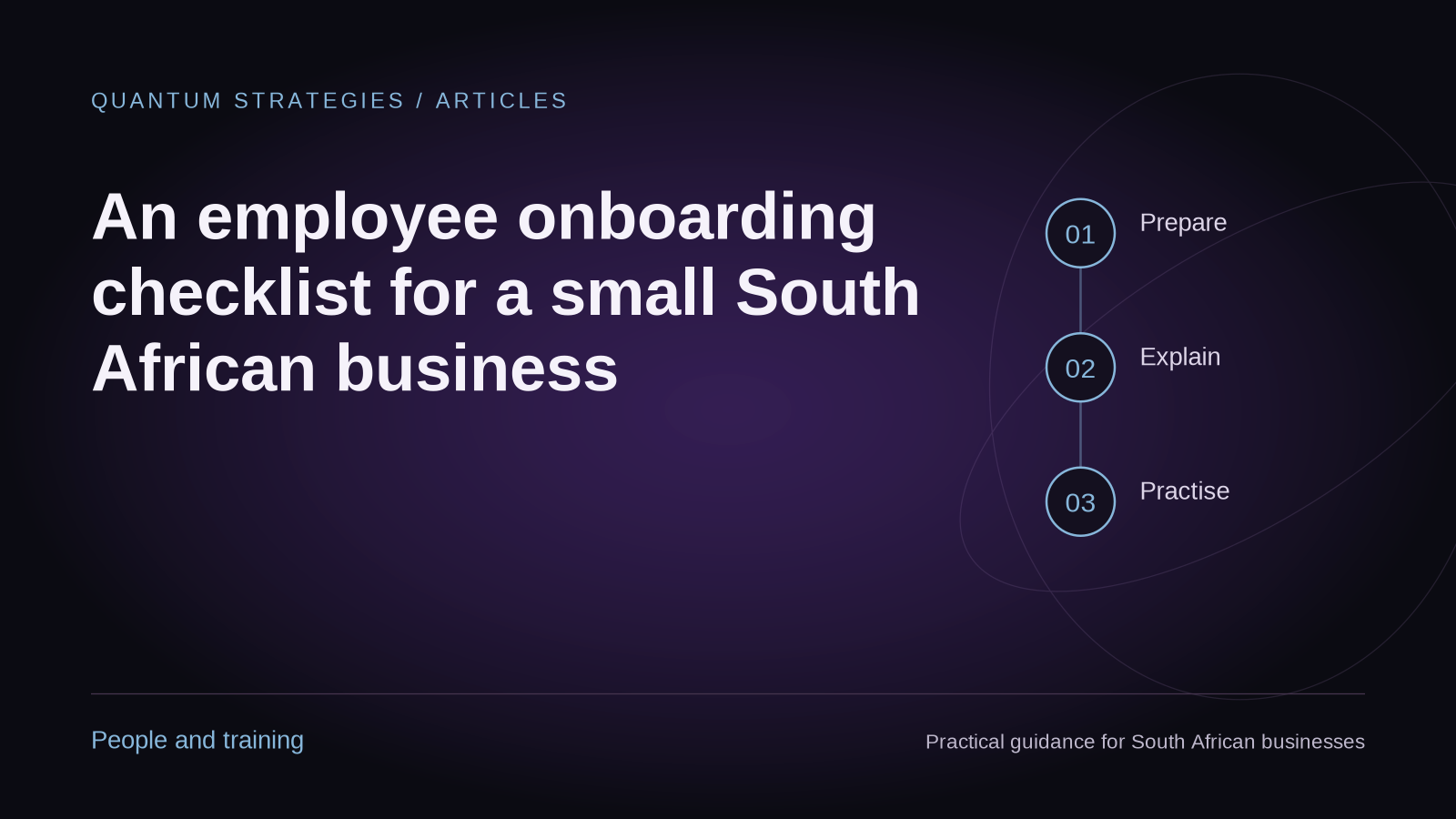
- Prepare people, equipment and permissions before day one.
- Demonstrate real tasks and check understanding.
- Record support needs and improve the process after each hire.
Prepare
People, access and equipment
Explain
Expectations and safety
Practise
Supervised work samples
Review
Support and next steps
Illustrative onboarding sequence; timing and supervision depend on the actual role.
Start with the role, not a pile of forms
Write down the job’s three most important responsibilities, the person who supervises it and the decisions the employee may make. For each responsibility, choose a real example of acceptable work. A receptionist may need to capture an enquiry accurately; a warehouse assistant may need to follow the approved receiving process before stock is accepted.
CIPD describes induction as helping a recruit settle in and gain the knowledge and support needed for their role. Use that purpose to decide what belongs in the programme. Keep essential first-day information separate from material that makes more sense after someone has seen the work.
Prepare before the employee arrives
Nominate one onboarding owner, even if several people contribute. Confirm the start time, reporting point, supervisor, dress or equipment requirements and how the person should contact you if arrangements change. Ask about practical access needs without collecting unrelated personal details.
Review employment documentation with appropriate HR support. Section 29 of the Basic Conditions of Employment Act addresses written employment particulars; the applicable conditions and any sector arrangements need checking for the actual appointment. This operational checklist is not a substitute for that review.
- Prepare the workstation, approved equipment and role-specific training materials.
- Create individual accounts with only the access the role requires; do not share an existing employee’s password.
- Arrange payroll information through the designated private channel and limit who can see it.
- Book time with the supervisor and a colleague who can answer routine questions.
Make day one manageable
Explain what the business does, whom it serves and how the new role affects customers and colleagues. Introduce the people the employee will actually work with. Show essential facilities, emergency arrangements and the method for reporting hazards or incidents. Safety instruction must fit the workplace and should be handled by a competent person.
Walk through one normal task slowly. Demonstrate, let the employee try with supervision, then ask them to explain the process back. Treat questions as information about your instructions. A signature confirms that a document was acknowledged; it does not demonstrate that somebody can perform a task correctly.
Use a first-month plan that people can follow
The timings below are an illustrative management schedule, not a statutory timetable. A complex or safety-critical role may need longer supervised practice. Record what has been demonstrated, what still needs support and who is responsible for the next step.
| Stage | Manager action | Useful evidence |
|---|---|---|
| Before starting | Prepare access and role expectations | Named owner and ready equipment |
| First day | Explain essentials and demonstrate one task | Employee can describe whom to ask |
| First week | Observe routine work and answer questions | Reviewed sample of actual work |
| Following weeks | Increase responsibility where appropriate | Agreed progress and support notes |
Worked example: onboarding an enquiry coordinator
Consider a fictional maintenance business hiring an enquiry coordinator. The first-week goal is to capture customer details, the service requested and the preferred contact time, then route the enquiry to the correct person. The coordinator is not authorised to promise a price or availability.
The supervisor prepares five fictional enquiries, including an urgent request and one outside the company’s service area. The employee practises recording and escalating each. If the employee struggles because the service-area list is unclear, the manager fixes the list before assuming more training is needed. Successful practice is followed by supervised real work; no client result is implied by this example.
Check progress through conversations and work samples
Ask what was clear, what was confusing and where the person had to guess. Review a small sample of completed tasks against the agreed standard. Include positive examples as well as errors. Agree a manageable next step, such as practising an escalation or shadowing a particular handover.
Keep onboarding records factual and private. Store only information that serves a clear employment or management purpose, using appropriate access and retention arrangements. If the discussion raises a formal employment issue, use the relevant HR process and obtain advice rather than treating an onboarding note as an automatic disciplinary decision.
Improve the checklist after each appointment
At the end of the first month, identify one instruction, access delay or unclear responsibility that made the job harder. Update the checklist while the experience is fresh. Reuse the structure for future hires but replace the tasks, risks and decision limits for each role.
Quantum Strategies’ HR consulting can help scope onboarding and people-management needs. Training and development support is relevant when a verified skill gap needs structured practice. Bring your role description, current checklist and examples of work so the discussion starts with the actual job.
Common questions
Does a small business need a separate HR system for onboarding?
Not necessarily. A controlled checklist, private records and clear ownership can be a workable starting point. Choose software only when it solves a demonstrated coordination or recordkeeping need.
When is onboarding complete?
Set role-specific completion criteria, such as demonstrating routine tasks and knowing escalation routes. Completing a calendar period or signing every page does not by itself demonstrate readiness.
Sources and further reading
Official and specialist sources checked on 28 October 2026. Examples and diagrams in this article are illustrative.
- CIPD: InductionPurpose of induction; reviewed July 2026. The proposed checklist and fictional example are original practical guidance.
- Basic Conditions of Employment Act, section 29Written employment particulars. Original official Act; no current wage, threshold or leave entitlement is stated.