What to take away
- Define the task before choosing the course.
- Use work evidence and employee input together.
- Check application and support, not only attendance.
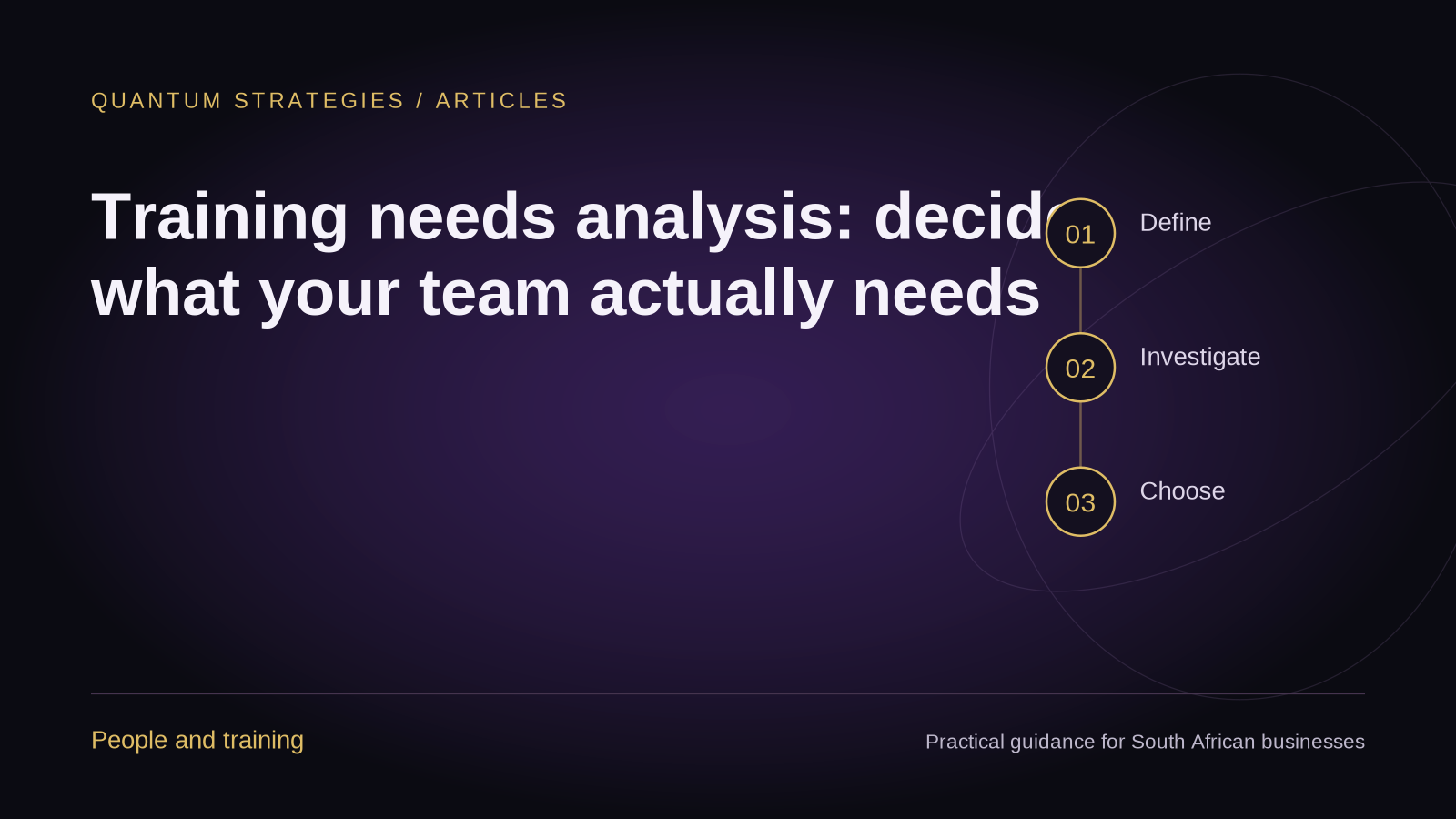
Define
Task and expected standard
Investigate
Evidence and underlying cause
Choose
Learning plus practical support
Check
Application in real work
Illustrative training-needs workflow; a process repair may be needed before training.
Start with a business task and its expected standard
Choose a concrete task such as preparing an accurate quotation, handling a customer complaint or interpreting a website report. Describe what competent performance looks like in your business. Use an approved sample, a checklist or a demonstration rather than a broad label such as “better digital skills”.
CIPD’s learning-needs guidance recommends examining information from several sources, including work observations, business data and discussions. The purpose is to understand the gap before selecting an intervention. For a small business, a focused review of one recurring task is often a manageable first exercise.
Collect evidence from people and work
Ask employees which parts of the task are difficult and what they currently do when they get stuck. Ask supervisors what they observe. Review a few work samples, taking care to remove customer or employee information that is unnecessary for the exercise.
Look for patterns rather than judging capability from one unusual event. A quiz may show that someone recognises a rule; it does not necessarily show that they can apply it under normal working conditions. Where safe and appropriate, use a short demonstration or simulation alongside discussion.
- What must the person be able to do?
- What evidence shows the current level of performance?
- Which part requires knowledge, practice or judgement?
- What tools, time, authority or information are missing?
- Who can confirm that the expected standard is appropriate?
Separate training from other corrective action
Use the table as a diagnostic aid, not a test that produces an automatic answer. More than one cause may be present. The employee who cannot explain a process may need training; the employee who understands it but cannot access the system needs a different intervention.
| Observed issue | Question to investigate | Possible response |
|---|---|---|
| Task steps are unfamiliar | Was the process taught and practised? | Demonstration and supervised practice |
| Different managers give different instructions | Is there one agreed standard? | Clarify the process and responsibilities |
| Work is repeatedly delayed | Are tools and inputs available? | Resolve access, workload or handover |
| Knowledge is present but application varies | What happens during real work? | Coaching, practice and feedback |
Prioritise gaps that matter to the work
Assess each gap against its operational consequence, frequency and urgency. A rare low-impact formatting issue should not automatically take priority over a recurring error that affects customers or safe work. Where work is regulated or safety-critical, obtain competent advice about required training, assessment and supervision.
Include readiness in the decision. There is little value in training a team on a system that has not been configured or on a procedure that is about to change. Identify dependencies first, then choose a learning activity the employee can apply soon afterwards.
Worked example: learning to read a marketing report
A fictional service business wants its administrator to explain monthly website enquiries. The owner initially asks for an advanced analytics course. A work review shows that the immediate gap is narrower: the administrator confuses page views, enquiry-button clicks and successful submissions.
The proposed plan is to practise identifying those three measures in a sample report, explain their limits and produce a short monthly note. The business also needs a technical check that the submission event works. Training and tracking repair are separate actions. The example does not claim that either activity will increase sales.
Write a brief that a training provider can respond to
Give the provider the audience, current capability, target task, work context and constraints. Explain whether learning will happen individually or as a team and whether practical assessment, coaching or materials are needed. Ask what is included and what the participant must arrange.
If certification or accreditation matters, verify the exact programme and issuing body before enrolling. A completion acknowledgement, attendance record and accredited qualification are different things. Do not assume that a familiar platform name makes a third-party course official.
- Define the observable outcome and a realistic practice task.
- Agree who will support application after learning.
- Confirm format, accessibility, time and access arrangements.
- Choose a review method before delivery, not after it.
Evaluate application, then decide what comes next
Compare a suitable work sample before and after training using the same standard. Ask what the person can now do, where support is still needed and whether process barriers remain. Attendance and learner satisfaction are useful records, but neither proves competent performance or business impact.
Quantum Strategies’ training and development service can help scope these needs. The public Practical AI and Understanding Google Analytics 4 course overviews explain their learning focus so you can compare them with the task you need to improve.
Common questions
Does every skills gap require a course?
No. A demonstration, job aid, coached practice or process change may be more appropriate. Choose the response after checking the cause and the required level of capability.
How can a small team measure training value?
Start with a task-specific baseline and review comparable work afterwards. Record changes in conditions, workload or systems so that you do not attribute every improvement to training.
Sources and further reading
Official and specialist sources checked on 28 October 2026. Examples and diagrams in this article are illustrative.
- CIPD: Learning needs analysisUse of organisational, work and stakeholder evidence in learning-needs analysis. Proposed worksheet, examples and evaluation choices are original guidance.