
What to take away
- Start with objectives and decisions.
- Define counts, denominators, timing and exclusions.
- Keep activity, submissions, qualified leads and sales distinct.
- Review evidence, assign action and check unintended incentives.
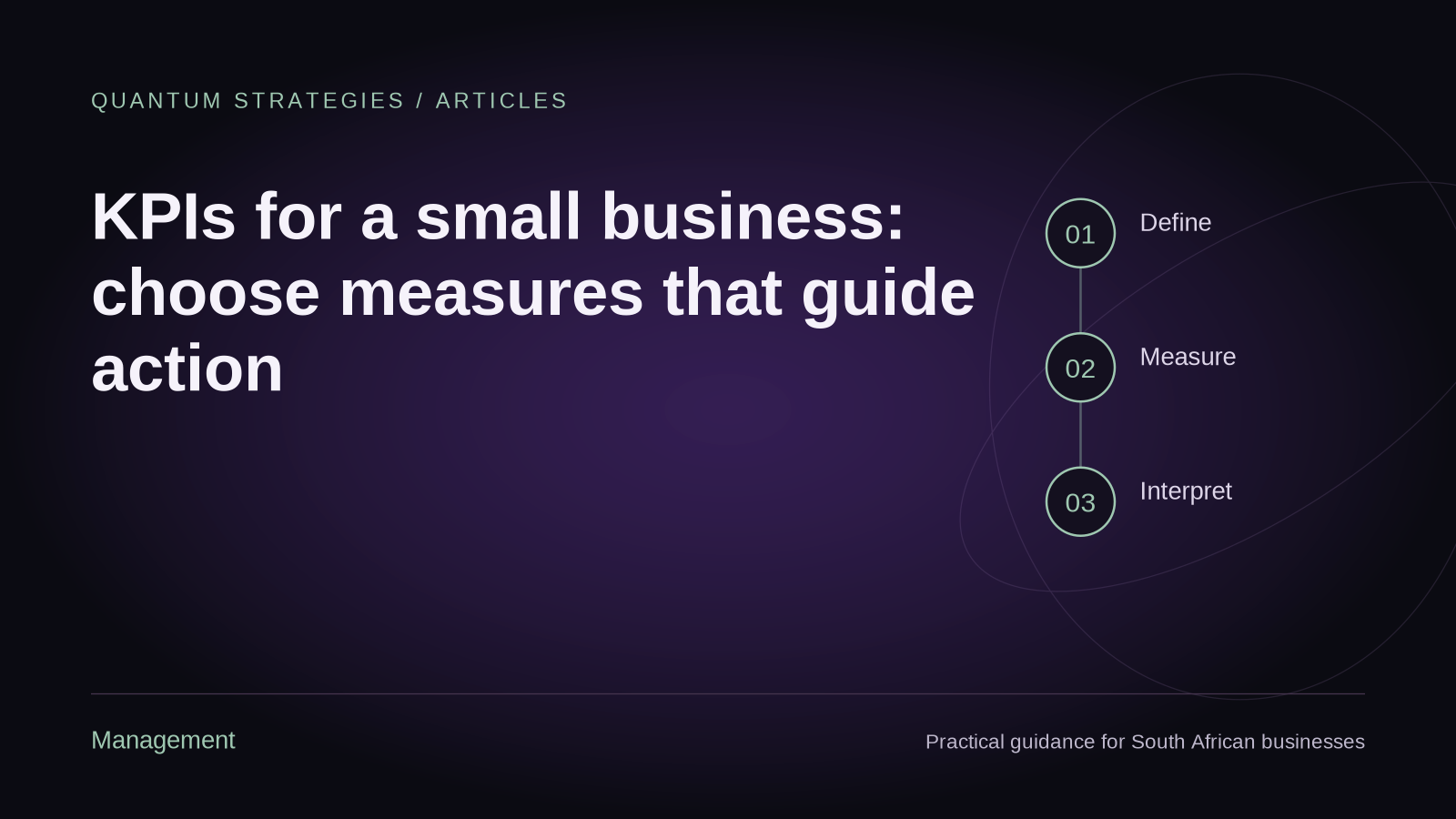
Define
Objective and formula
Measure
Reliable source and period
Interpret
Context and limitations
Act
Owner and follow-up
Illustrative management cycle; a dashboard is only one part of the process.
Start with the decision behind the measure
Name the objective before choosing the KPI. If the objective is more reliable delivery, total revenue does not directly reveal whether promises are being kept. If the objective is better-quality enquiries, website visits alone are insufficient. Ask what action you would take if the measure improved or deteriorated.
BDC’s guidance on measuring a strategic plan distinguishes milestones from performance measures and links metrics to strategic objectives. A completed website launch is a milestone. The rate of successful enquiries from appropriate visitors is a different measure, requiring ongoing data and a clear definition.
Define the numerator, denominator and time period
A label such as “conversion rate” can mean several things. Specify exactly what is counted and what it is divided by. Decide how duplicates, cancellations, test records and missing information are handled. Record the period and data source so another person can reproduce the calculation.
For a service business, “qualified enquiries” needs a written definition. It might involve service fit, a genuine need and sufficient information for follow-up, but your criteria should match the business. Keep an enquiry submission separate from a qualified lead, a signed proposal and a paid sale. They represent different stages and should not be combined into one success count.
- Name and purpose: what decision does the KPI support?
- Formula: precisely which records enter the numerator and denominator?
- Source: where does the data come from and who checks it?
- Period: when is it measured and what comparison is meaningful?
- Owner: who investigates changes and coordinates action?
- Limitations: what missing data, delays or exclusions affect interpretation?
Illustrative example: enquiry quality and sales progress
Suppose a business receives 40 unique enquiries in a month. After review, 24 meet its stated qualification criteria. The qualification rate is 24 divided by 40, or 60%. Ten of those qualified enquiries reach a quotation and four eventually become accepted projects. These numbers are illustrative, not Quantum results or industry benchmarks.
The timing matters. If the four accepted projects include enquiries from earlier months, dividing them by this month’s 24 qualified enquiries does not produce a clean conversion rate for that group. Either follow the same enquiry cohort through the process or label the figures as separate period counts.
The owner should ask where suitable enquiries stop progressing and why. More website traffic may be useful, but it does not automatically resolve slow follow-up, unsuitable requests or unclear proposals.
| Measure | Illustrative definition | Decision it can inform |
|---|---|---|
| Qualification rate | Qualified unique enquiries ÷ all unique enquiries | Offer clarity and audience fit |
| Quotation progression | Same-cohort qualified enquiries reaching quotation | Follow-up and sales process |
| Accepted projects | Accepted work, with enquiry cohort identified | Proposal outcomes and capacity |
Balance outcome measures with early signals
Revenue, profit and completed orders show results after work has happened. Earlier signals can help identify a developing issue, such as unresolved customer questions, overdue quotations or work waiting for approval. Use them together rather than assuming activity guarantees an outcome.
For delivery, combine on-time completion with rework or customer complaints. Otherwise, staff might improve the timing measure by closing jobs before they are properly complete. For cash, review overdue receivables alongside the forecast balance. A measure should encourage the behaviour the business actually wants, with a check against unintended shortcuts.
Set targets from evidence and capacity
Establish a baseline using reliable data before setting an improvement target. Consider the operating process, resources and trade-offs. A target chosen because it sounds ambitious can distort decisions or encourage people to manipulate the definition.
Use ranges or warning thresholds where they better reflect uncertainty. Record why a threshold was selected and what response it triggers. Compare like periods and explain changes in customer mix, staffing or seasonality. Small businesses often have small counts; one large order or a few unusual cases can create a dramatic percentage movement without establishing a lasting trend.
Create a review routine that ends in action
At each review, check whether the data is complete, what changed and which explanation is supported. Separate an observed movement from a suspected cause. Assign an investigation or action with an owner and date, then revisit it. Avoid spending the whole meeting explaining the chart without deciding anything.
Retire measures that no longer support a useful decision. Keep definitions stable where possible, and mark changes so historical comparisons remain understandable. Protect personal information: a shared dashboard rarely needs customer names, email addresses or detailed private notes. Aggregate results and keep sensitive case-level records in the appropriate system.
Begin with a small, trustworthy dashboard
Choose a few measures covering the immediate priorities rather than every available metric. A spreadsheet with clear definitions and a regular review can be more useful than an automated dashboard built on inconsistent records. Automate only after the counting rules and source data are understood.
Management consulting can help connect responsibilities and reviews to business objectives. Financial consulting can support financial reporting definitions. For website measurement, the Understanding Google Analytics 4 course overview is a relevant learning route. Website analytics should be connected carefully to verified enquiry and sales records, without sending personal information in analytics fields.
Common questions
How many KPIs should I track?
Start with the few measures needed for current decisions and expand only when there is a clear use. The right number depends on the business; each KPI creates a data and review obligation.
Are website visits a useful KPI?
They can describe traffic, but usually need context such as relevant landing pages and successful enquiry outcomes. Visits alone do not establish qualified leads, revenue or customer value.
Can I compare this month’s sales with this month’s leads?
You can describe both period totals, but a sales conversion rate needs a compatible denominator. Where sales take time, follow a defined group of leads or clearly explain the timing limitation.
Sources and further reading
Official and specialist sources checked on 28 October 2026. Examples and diagrams in this article are illustrative.
- BDC: How to measure the success of your strategic planTie performance measures to strategic objectives; distinguish milestones and KPIs and review measures with the team.