What to take away
- Define the workflow before shortlisting products.
- Test each option using the same realistic tasks.
- Budget for ownership, migration and a reversible pilot.
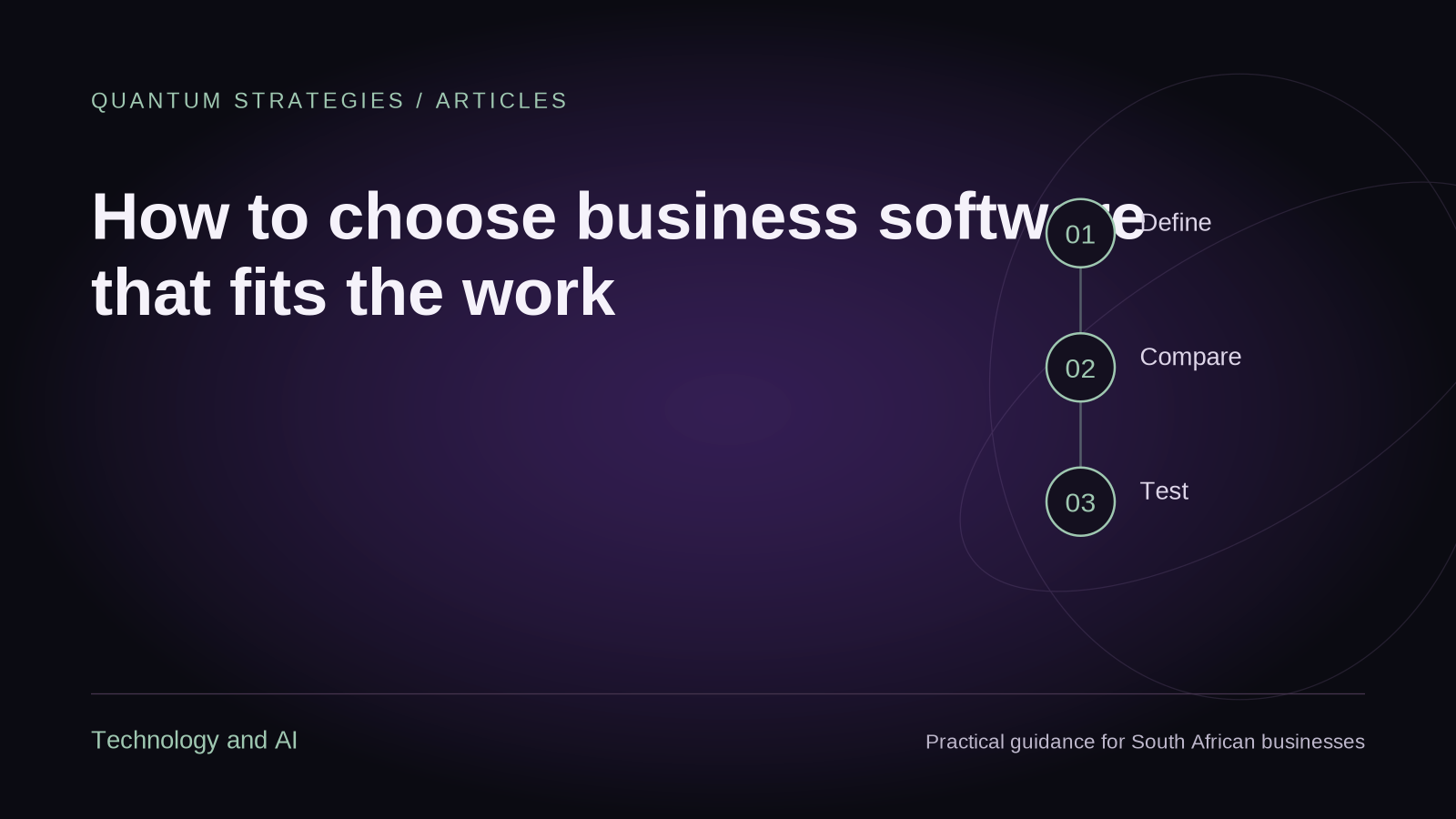
Define
Workflow and requirements
Compare
Cost and supplier evidence
Test
Real tasks and exceptions
Pilot
Measure before expanding
Illustrative selection process; the pilot should be proportionate and reversible.
Describe the problem in operational terms
Replace “we need a CRM” with a statement such as “enquiries are spread across three inboxes and nobody can see which ones need a reply”. The second statement lets you test whether a simpler process change or a new system is the appropriate response.
Map the current workflow from input to completed outcome. Identify the people involved, the information they need and the points where work is delayed or repeated. Include the exceptions: duplicate enquiries, cancellations, missing information and staff absence. These are often more revealing than the normal path used in a demonstration.
Turn the workflow into testable requirements
Separate essential requirements from preferences. An essential requirement should have a clear reason and a way to test it. “Easy to use” is difficult to verify; “a new staff member can record an enquiry and assign it using our instructions” is more concrete.
Include permissions, reporting, mobile use, accessibility and integration needs where they matter to the task. Do not assume that a feature advertised for the product is included in the subscription tier you are comparing. Ask for the exact plan, limits and dependencies.
- Which tasks must the system support on the first day?
- Who creates, approves, changes or views each record?
- Which information must move to another system?
- What happens if connectivity is interrupted?
- What reports do people actually use to make decisions?
- How will the business retrieve its information when leaving?
Compare total cost and practical ownership
Calculate more than the monthly subscription. Include setup, migration, additional users, integrations, training, support and any expected charges for storage or usage. Where a price is in another currency, show the exchange-rate assumption and recognise that the future cost can change.
Assign an internal owner. Someone must manage access, answer routine questions, maintain reference data and review supplier changes. Outsourcing support does not remove the need for an accountable person in the business. Confirm which tasks the supplier performs and which remain yours.
Check security and supplier evidence
The UK National Cyber Security Centre’s cloud-provider guidance recommends assessing security against the intended use and the impact of data loss, corruption or unavailability. That is useful technical guidance, not a statement of South African legal compliance.
Ask for evidence relevant to your particular service and configuration: access controls, multifactor authentication, backup and recovery arrangements, incident handling and the responsibilities of each party. If a supplier cites a certification, check its scope and currency. A badge alone does not show that your chosen configuration meets your requirements.
Run the same practical demonstration with each shortlist option
Give every supplier the same fictional test scenario and expected outcome. Ask them to show the actual workflow, including an exception and a data export. Record what was demonstrated, what requires configuration and what was only described as possible.
| Test task | Evidence to record |
|---|---|
| Capture and assign an enquiry | Steps, required fields and ownership visibility |
| Restrict a user’s access | What the user can and cannot see |
| Correct a record | Change history and effect on reports |
| Export information | Format, completeness and practical usability |
| Recover from a problem | Documented process and responsible party |
Worked example: choose an enquiry system
A fictional service business shortlists two systems. Option A has more automation but requires a separate integration to send an enquiry to the delivery team. Option B has fewer features but completes the required handover within the quoted plan. The team tests both using the same fictional enquiries.
They also discover that neither system fixes an unclear rule about who accepts a new job. The business agrees that rule before choosing. The example illustrates why feature count is not a sufficient decision criterion; it does not establish that one type of product is generally better or cheaper.
Pilot before moving every record
Choose a limited, reversible pilot with named users, a defined workflow and clear success criteria. Use fictional data initially, then move real information only when the necessary permissions and controls are in place. Keep a recovery plan and verify the migration rather than assuming that a successful import means all records are correct.
Ask users to record difficulties and workarounds. Test the reporting, export and support route as well as the main screen. Decide whether to expand, change the configuration or stop based on the agreed criteria. Include training time in the rollout plan.
Make the decision reviewable
Keep a short decision record covering the requirements, evidence, total-cost assumptions, unresolved risks and reasons for the choice. This helps future staff understand why the system was selected and when the decision should be revisited.
Quantum Strategies’ IT consulting can help scope software selection and implementation. Operations consulting is relevant when the workflow needs clarification first. Bring a process example and current system list so the discussion can focus on the work rather than a product catalogue.
Common questions
Should a small business build custom software?
Consider it only after defining requirements and comparing maintainable alternatives. Custom work creates responsibilities for support, security, updates and continuity that need an explicit owner and budget.
Is a free trial enough to choose a system?
Only if it tests the tasks, permissions, data movement and limitations that matter. A trial spent exploring attractive screens may leave the difficult requirements unanswered.
Sources and further reading
Official and specialist sources checked on 28 October 2026. Examples and diagrams in this article are illustrative.
- National Cyber Security Centre: Choosing a cloud providerRisk-based security due diligence, shared responsibilities and assurance evidence. UK technical guidance is not presented as South African law; selection framework is original.