What to take away
- Plan from customer questions and verified offer facts.
- Give each post a purpose and a suitable destination.
- Use a manageable review cycle instead of filling dates mechanically.
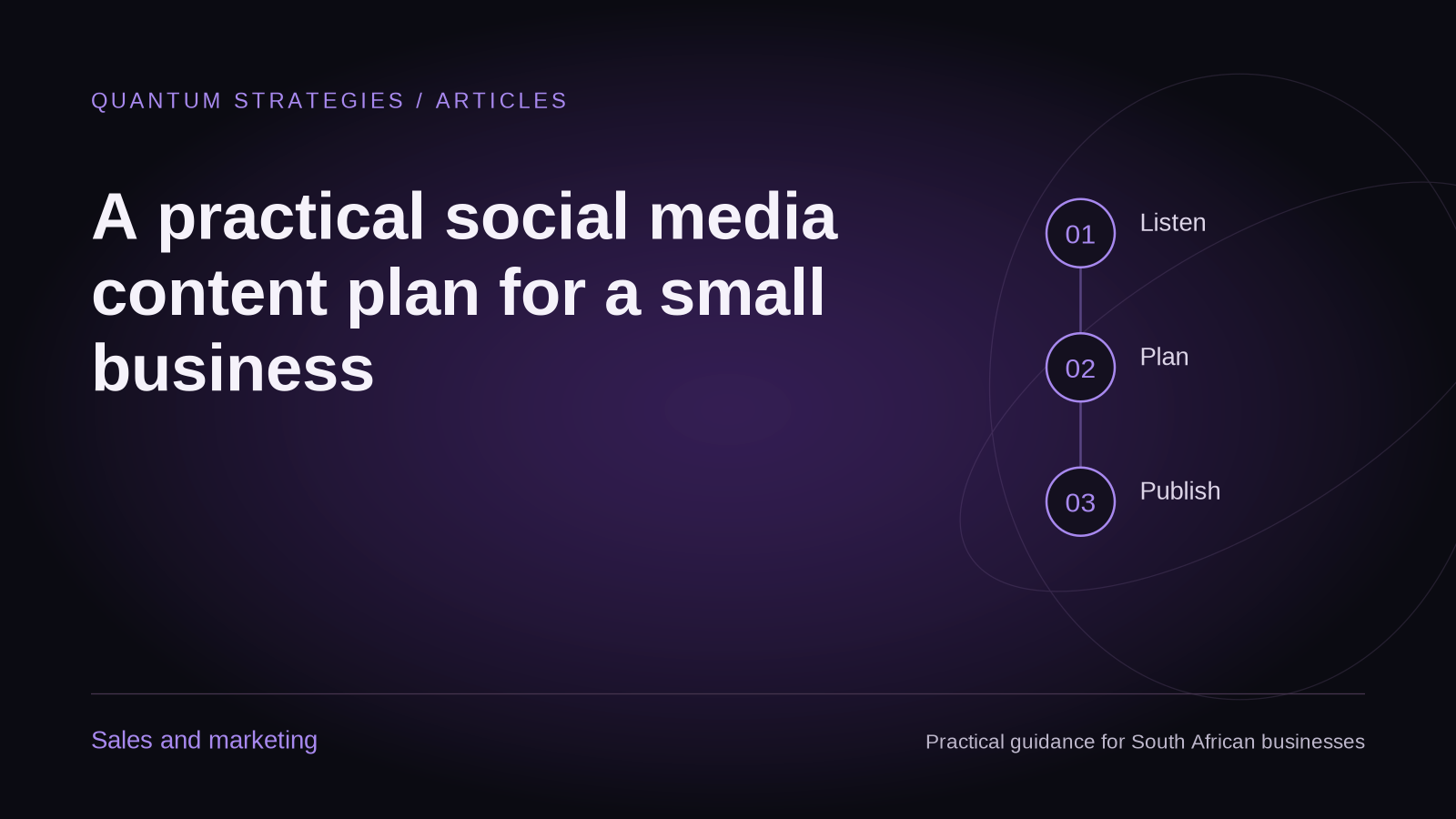
Listen
Customer questions
Plan
Message, evidence and action
Publish
Reviewed content
Learn
Relevant response and next change
Original illustrative planning cycle, adaptable to the platform and the team’s capacity.
Choose one audience and one purpose for the plan
Describe the person in terms of a relevant need rather than an invented personality profile. For example, an owner comparing training options may need to understand what the course covers, whether it suits beginners and how access works.
Decide what the next month’s content should help that person do. The purpose might be to understand a service, prepare for an enquiry or learn a useful task. Avoid expecting every post to create an immediate sale. Some content answers an early question; other content supports a decision already being considered.
Build topics from questions people actually ask
Review enquiries, sales conversations and approved customer feedback. Remove personal details and identify recurring questions. Separate genuine observations from assumptions you still need to test. A small list of useful questions is a stronger starting point than a large list of generic awareness days.
LinkedIn’s small-business guidance recommends a content calendar and reviewing analytics when planning. The practical framework here is independent of any one platform: select topics that fit your offer, check the evidence and choose a format suited to the message.
- What does the service or product include?
- Who is it suitable for, and where are the limits?
- What should a customer prepare before enquiring?
- How does the process work?
- Which common mistake can we help someone avoid?
- What genuine evidence can we share with permission?
Use a few repeatable content types
Choose types that your team can create well: an answer to a common question, a short process explanation, an approved example of work, a practical tip or a clear offer. Each should have a reason to exist and a suitable next step.
Do not invent testimonials, client results or behind-the-scenes stories. If you use a fictional example to explain a service, label it as illustrative. For real photographs, documents or customer stories, confirm the right to publish and remove information that should remain private.
Create a calendar that records the decision behind each post
A useful calendar includes the audience question, key message, format, evidence, owner, review status and destination. Add the publishing date only after those basics are clear. This prevents the calendar from becoming a list of dates that someone must fill at the last minute.
| Illustrative week | Customer question | Possible content | Next step |
|---|---|---|---|
| Week 1 | Is this service relevant to me? | Plain explanation of scope and audience | Read the service overview |
| Week 2 | What would we need to prepare? | Short preparation checklist | Save the checklist or review the guide |
| Week 3 | How does the process work? | Original step-by-step diagram | Understand the enquiry process |
| Week 4 | What should I do next? | Clear offer with confirmed limitations | Make a relevant enquiry |
Worked example: a small training provider
A fictional training provider chooses a month focused on helping supervisors give clearer feedback. It publishes an explanation of the skill, a preparation checklist, an illustrative conversation example and a post linking to the training overview.
The posts use the same underlying topic but answer different questions. The example does not assume a particular posting frequency, reach or sales result. If the team can only produce two useful pieces, it can combine the sequence rather than publish weak material to meet an arbitrary quota.
Make each post usable on its own
Put the useful point early. Use plain language, readable spacing and an image only when it adds information. Provide meaningful alternative text where the platform supports it, and do not place essential instructions only inside an image.
Choose one primary action. A post can ask the reader to review a guide or make an enquiry without also requesting a follow, share, comment and purchase. Check that the destination works on mobile and explains the same offer. Avoid a detailed post that sends everyone to an unrelated homepage.
Set a small production and approval routine
Batch related work where helpful: gather source facts, draft, review, prepare visuals and schedule. Give one person responsibility for factual checks and another for any specialist approval the subject requires. A short checklist can catch outdated prices, unsupported promises and broken links.
Keep the plan flexible enough to respond to real questions or changes in availability. If an offer changes, review scheduled posts as well as the website. A calendar is useful only while its information remains accurate.
Review the plan using signals that fit its purpose
Look at the questions raised, the destinations visited and the relevant enquiries received. Platform engagement can help identify topics people interact with, but it does not establish sales. Record what you will keep, revise or stop and why.
Quantum Strategies’ marketing consulting can help scope a content plan around the actual offer and customer journey. The public Social media, made simple overview offers a learning route for people who need a clearer starting process. Course access and included support should be checked through its enquiry route.
Common questions
How often should a small business post?
Choose a sustainable rhythm that lets you publish accurate, useful material and respond to people. Test it against your own audience and objectives rather than treating a generic frequency as a rule.
Can we reuse one topic in several posts?
Yes, when each post answers a different useful question or uses an appropriate format. Avoid repeating the same sales message with only minor wording changes.
Sources and further reading
Official and specialist sources checked on 28 October 2026. Examples and diagrams in this article are illustrative.
- LinkedIn: Small-business Pages action planContent-calendar and analytics-review principles. No platform posting-frequency formula or performance statistic is adopted; calendar and example are original.