What to take away
- Map the real activity and location before choosing the assessment.
- Review proposed changes before implementation.
- Keep authorisations, operating controls and evidence distinct.
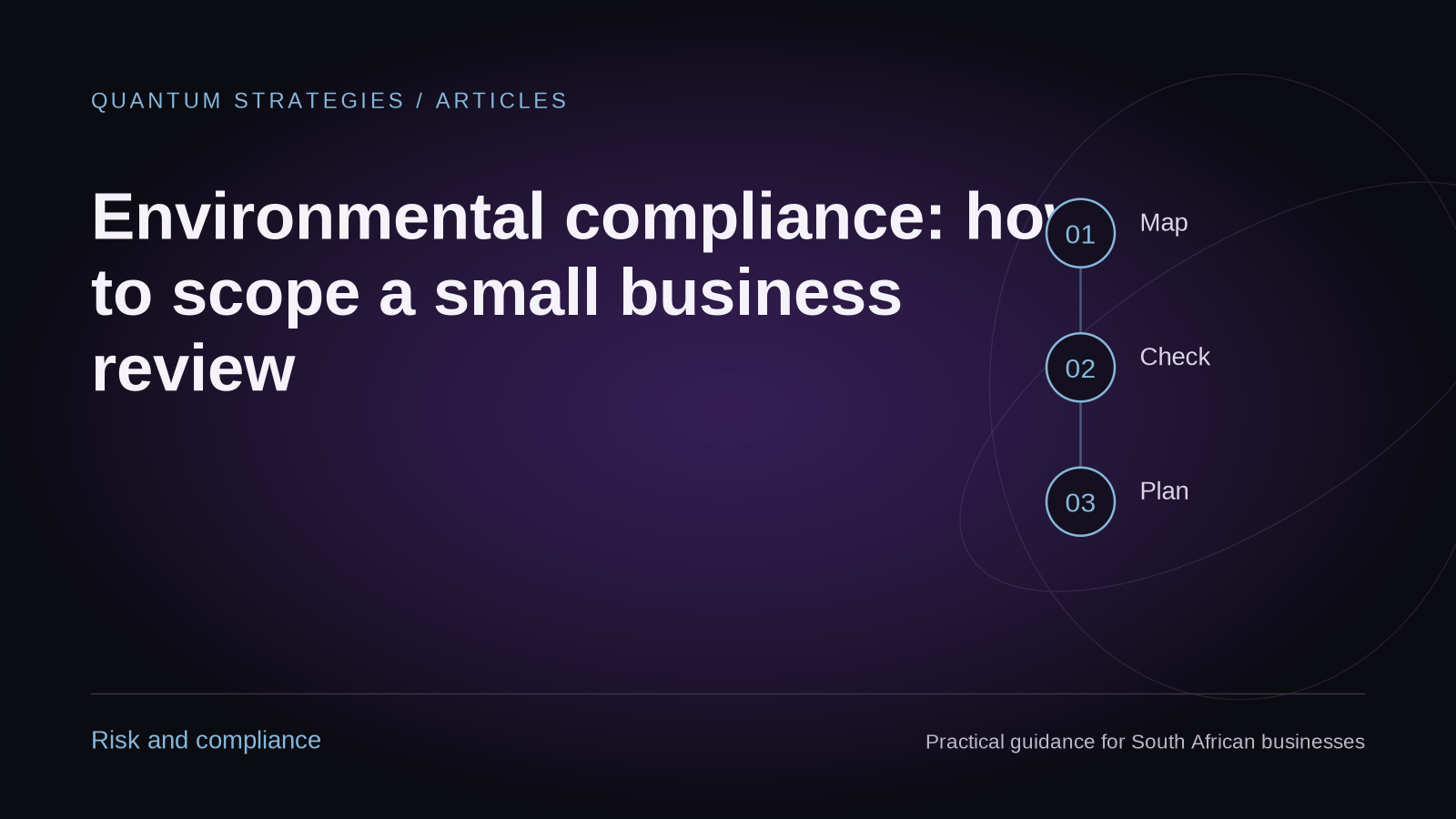
Map
Activities and location
Check
Applicable requirements
Plan
Actions and specialist work
Maintain
Records and change reviews
Illustrative preparation workflow, not an authorisation decision.
Describe the activity before asking for a certificate
Begin with a plain description of operations: what comes onto the site, what happens to it and what leaves. Include normal production, cleaning, maintenance, storage, transport and unusual events such as spills or shutdowns. Note planned changes as well as current activity.
The National Environmental Management Act provides an important part of South Africa’s environmental framework. Requirements also arise through activity-specific legislation, authorisations and local rules. A generic “compliance certificate” is therefore not a substitute for identifying the requirements and evidence relevant to a particular operation.
Build a site and activity profile
Give the reviewer the physical location, site boundaries, land use and surrounding features. Identify drains, watercourses, neighbouring properties and areas used for storage or waste. Distinguish what the business controls from what a landlord, contractor or shared facility manages.
Use measured or documented information where available and clearly label estimates. Do not quietly replace a missing quantity with zero. If records are incomplete, write down how you will establish a more reliable figure. Photographs and a simple layout can help a reviewer understand the operation, provided they are current and appropriately shared.
- Products, raw materials and chemicals used or stored.
- Waste streams, storage arrangements and collection records.
- Water sources, uses and discharge destinations.
- Equipment or processes associated with emissions, dust, noise or odour.
- Existing authorisations, conditions, inspections and incident records.
- Proposed building work, expansion or process changes.
Separate different questions about permission and control
The national environmental authorisation system instructs applicants to identify the competent authority and relevant listed activities or waste categories before construction begins. A planned change therefore deserves review before work starts, rather than after equipment has been installed.
Ask the reviewer to distinguish authorisation requirements, operating conditions, monitoring duties and practical controls. These are connected but not interchangeable. A waste collection invoice, for example, records a transaction; on its own it cannot establish that every part of waste handling meets the applicable requirements.
| Area to review | Question for the assessment |
|---|---|
| Site development | Does the proposed change trigger an assessment or authorisation process? |
| Waste | What is generated, how is it classified and where does it go? |
| Water | What use or discharge occurs and which requirements apply? |
| Air, noise and neighbours | Which activities create impacts and which controls are required? |
| Existing permissions | What conditions, reporting and renewal duties must be met? |
Worked example: a workshop considering expansion
A fictional workshop plans to add a washing area and store more cleaning chemicals. The owner prepares a layout, product information, estimated use volumes, drainage details and existing waste records. They do not assume that the current site arrangements cover the new activity.
The review brief asks which requirements apply to the proposed activity and location, what evidence is missing and what must happen before implementation. The example is deliberately not a finding that a licence is required or unnecessary. That determination needs the actual facts and a current review of the applicable rules.
Ask for a clear, bounded review proposal
An environmental consulting proposal should explain the activities and sites covered, the information required, the specialist work included and the limits of the review. Confirm whether site visits, sampling, laboratory work, authority engagement or formal applications are included or separately scoped.
Ask who will perform any work requiring particular competence or professional registration. Do not infer that a general advisory engagement includes every statutory role or technical sign-off. Request the basis for findings so that your business can distinguish a confirmed obligation from a question requiring further investigation.
Turn findings into an action register
Create a register with the requirement or issue, supporting evidence, responsible person, action and review date. Record uncertain items as open questions rather than marking them compliant. Where a serious incident or suspected unlawful activity is identified, obtain prompt competent guidance on the required response; a future improvement plan is not permission to continue.
Prioritise using the severity of the potential impact, the applicable obligation and the timing of the proposed work. Keep operational actions, specialist assessments and authority decisions separate so that one completed task does not imply that the entire matter is closed.
Keep the scope current as the business changes
Review the register when activities, materials, quantities, equipment, contractors or premises change. Keep accessible copies of conditions and records that the responsible staff need, with an owner for each ongoing duty. Schedule checks that test actual practice, not just whether a folder exists.
Quantum Strategies’ environmental consulting can help scope environmental compliance work for the business. Bring a site description and the available records to the initial enquiry. The appropriate specialist involvement, deliverables and limitations should be agreed before the work begins.
Common questions
Does every small business need an environmental impact assessment?
No universal answer follows from business size alone. The activity, scale, location and applicable rules need assessment. Obtain a current determination for the proposed work before relying on an assumption.
Can the landlord’s paperwork cover all our activities?
Do not assume so. Ask which permissions and conditions apply to the premises, which apply to your operation and who is responsible for each duty. Your reviewer needs the actual documents and activities.
Sources and further reading
Official and specialist sources checked on 28 October 2026. Examples and diagrams in this article are illustrative.
- South African Government: National Environmental Management ActEnvironmental governance framework; government page lists amendments. No site-specific legal conclusion or threshold is stated.
- Department of Forestry, Fisheries and the Environment: National Environmental Authorisation SystemCompetent authority and listed-activity or waste-category identification before construction. This article does not determine the requirements for any particular site.